DIGITIZING COUNTY RECORDS:
TROUP COUNTY COURT AND GOVERNMENT RECORDS
NHPRC FINAL REPORT
NAR07-RD-10013-07
January 1, 2007 – May 31, 2009
1. Objectives:
a) flattening and scanning 53 linear feet of Troup County court records
b) Converting the Guide to Troup County Records to EAD and using automated scripts to create folder level records
c) Linking the scanned images to the folder level EAD records
d) Creating microfilm of the scanned images for long-term preservation
e) Testing the usability of the digitized materials with at least two focus groups and reporting on the results of the tests
f) Developing tracking methods to explore use of the digitized collection and compiling annual reports for at least three years after completion of the project
g) Developing a website that publicizes the project and describes the processes used at both the Troup County Archives and the Digital Library of Georgia
h) Publicize the project and its methods through press releases, announcements on appropriate listserves, articles in at least two publications, and presentation of the project during at least one professional conference.
2. Summary of Project Activities
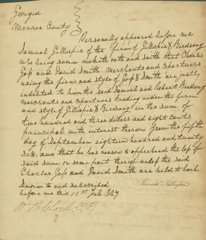
The Troup County Scanning Project has been successfully completed. The full 53 linear feet of Troup County court records were flattened, scanned, and posted on the Digital Library of Georgia website. 76 years of court records have been scanned meeting our goal of scanning all the 19th century court records for the county, which date from 1825 to 1900. Scanning was performed in accordance with guidelines prepared by staff of the Digital Library of Georgia. Converting the 1986 finding aid for the Troup County court records into a Microsoft Word file and then to an EAD file was a critical component of the project.
The Troup County Archives kept five part-time staff members busy scanning for much of the grant period. The Troup County Archives staff has worked with the Digital Library staff to name and number image files to match the finding aids. Additionally staff at both institutions worked to link files with the database. Finally, a blog created to chronicle progress of the project was updated periodically.
3. Accomplishments
a) Flattening and Scanning
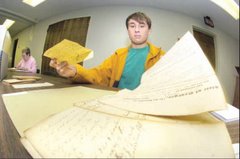
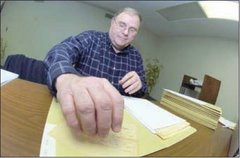
Eleven people volunteered at the Troup County Archives (TCA) to assist in flattening the documents and prepare them for scanning. A total of 600 volunteer and staff hours were spent completing the project. Flattening was completed during the spring of 2007.
In mid-May, 2007, staff began scanning the flattened documents. During the first period of the grant, three linear feet were scanned. By January 2008, an additional 10.5 linear feet of materials have been scanned. By July 2008, 29.5 linear feet have been scanned out of a total of 53 linear feet. As of December 31, 2008, 39 linear feet have been scanned. Finally, by May 31, 2009, all 53 linear feet originally recommended for the project were scanned. Due to the fragile and unique nature of the 19th century court records, scanning preceded slowly, though the pace picked up considerably after the first few months. Two members of our scanning staff averaged 25 to 30 hours per week. We tried to have three additional people to work on the scanning project when the regular staff members are off duty. During the last year of the project, scanning was done 95% of the time during the hours we are open. (This is one of those areas where small institutions may struggle more than larger places that have more staff and more student assistants to call upon.) Eventually, we came up with a system to have scanners going almost full time.
Despite the juggling of staff members and working hours, plus the need to ask for an extension for the project, we were delighted that the full span of years, 1825-1900, was completed during the grant period. We can tell scholars and other users of the materials that all the 19th century loose court records have been scanned and made available on the DLG website.
b) EAD Conversion
A consultant who works with the Digital Library of Georgia as her full-time job (Sheila McAllister) completed EAD conversion of the 1986 finding aid. Ms. McAlister authored a Perl script to generate the folder-level DC metadata records. She also directed Archives staff on how to name the individual scans and documents – a critical component in making sure files and inventory listings matched up. (Note: this part of the project was billed to the grant during the January 2009 – May 2009 cycle.)
McAllister reports:
The finding aids for the project are available at http://dlg.galileo.usg.edu/troup/
Dublin Core records for these may be searched at: http://dlg.galileo.usg.edu/CollectionsA-Z/court_search.html.
c) Linking scanned images to EAD
At the end of the grant period in May, 2009, the Troup County Archives had delivered approximately 3029 gigabytes or 136,428 images to the Digital Library of Georgia for processing. TCA and DLG staff performed quality reviews of the documents. DLG staff then generated test derivative files (pdf/djvu), and made adjustments to the workflow to more thoroughly automate the cropping and de-skew process. The goal was to automatically link scanned images with the finding aid. During the early and middle months of the grant, DLG staff also checked the scanned images and the file names used. A few images had to be rescanned. By late 2008, the majority of the quality control work began to be done by Troup County Archives staff. Folder naming and numbering, deskewing and cropping were the major items carefully examined during quality control phases.
d) Creating microfilm
We originally intended that this be done during the grant period but due to time constraints, we decided this would be done after the scanning was completed. We have been in consultation with staff at the Georgia Department of Archives about having microfilm created from the scanned images. The Troup County Archives always planned to pay for the creation of microfilm from local funds and will do this.
One note: should staff at Georgia Archives or Troup County Archives decide that it is not economically feasible or practical to create microfilm from the scanned images, we do believe we have enough redundancy built into the system to keep the scans available to the public. Copies of actual files are in digital storage at DLG and TCA. Should microfilm not be created, then we expect to file a 3rd digital copy at State Archives.
DLG staff and TCA staff are committed to making sure that forward migration of files is done at the appropriate time. The files are currently high quality tiff files, an industry standard. At some point in the future, should it appear that tiff files are no longer accepted formats; the files will be converted to other acceptable file types.
e) & f) testing the usability of the digitized materials and developing tracking methods These two aspects of the grant will be explored in more depth in coming months. The Digital Library of Georgia has added measures to look at page viewing and time spent on these parts of their collection. We will be looking at use statistics as the months pass. As for testing the usability of these digitized 19th century court records, this was done at the Troup County Archives using genealogists and local historians. Everyone was very happy with the layout of the DLG site and with the basic finding aid structure. Many times, the actual scanned image is easier to read than the original document. The scanned image can more easily be enlarged and contrast levels adjusted than the original can be. Such adjustments make reading the scanned document easier than reading the original. The real test will be as historians and genealogists not connected with DLG or with TCA begin to use the collection in their research. The main questions will be whether the collection enables them to find needed materials and in a timely fashion.
g) Developing a website that publicizes the project and describes the processes used at both the Troup County Archives and the Digital Library of Georgia has been in place for most of the grant project. A blog was created and has several articles on it, including an article describing the flattening process and also the EAD conversion process. The blog can be seen at http://troupscanning.blogspot.com/. This blog will be updated with final results in the next few weeks. During the project, we realized maintaining the blog takes committed effort. If the future, if we decide to do a blog or a similar website, different people will be assigned responsibility for adding to the blog in different weeks and different months in an effort to keep the blog fresh and lively.
h) Publicize the project
The LaGrange Daily News has included several articles about the grant, including one top of the fold, at the beginning of the project. Additionally, the Troup County Historical Society newsletter has included several articles. The project has been mentioned in the newsletter of the Association of County Managers and in an article in the Atlanta Journal Constitution about the IMLS “Preserving America” conference. An article in Annotations about the project was released in Spring 2009. In future months, efforts will be made to have additional articles about the availability of the actual files on the DLG website in the LaGrange, Atlanta, Columbus, and West Point, GA., newspapers plus in newsletters and journals of professional publications, including Provenance and American Archivist.
Project Director Kaye Minchew was a speaker in a panel discussion about digitizing collections in the 2008 Annual meeting of the Society of American Archivists in San Francisco. She prepared a one-page article for Outlook, the newsletter of the Society of American Archivists for their September-October issue. We are also seeking to have an article in Provenance, the Journal of the Society of Georgia Archivists and in American Archivist. Finally, Minchew was on a panel at the 2009 annual meeting of the National Association of Government Archivists and Records Managers talking about scanning projects. At the 2008 SAA meeting, the Troup County Archives received the “Council’s Award for Exemplary Service.” This tremendous honor helps draw attention to the award.
4. Assessment
The original goals of this project generally appear to have been overly optimistic regarding the time involved though the goals of the project were met with a time extension. Now that the report is completed, we are more convinced than ever about this scanning project being a model for other scanning projects. We firmly believe that creating minimal metadata and spending minimal time processing the collection is an excellent way to do archival scanning projects.
At TCA, we are trying to follow this example in processing projects at the Troup County Archives with both manuscript collections and government records. Specifically, we are currently doing a major updating and revising of the Troup County Archives’ website (www.trouparchives.org). With the new website, we plan to include for the first time lists of government records and be ready to insert scanned pages as they become available. For instance, in June, 2009, we began scanning pages of Troup Inferior Court minutes. The Inferior Court heard both misdemeanor cases and acted as county commissioners in the early decades of Troup County’s existence. On the website, we will post scans of the pages and include very brief descriptions about the minute books. We expect to do similar processing of manuscript collections and hope to include scanned images of some of our most popular collections.
SPECIFICS: Things always take much longer than expected. I doubled the expected time for scanning documents when writing our grant proposal but still underestimated the time the project would require.
Staff can often cause delays. We started out by hiring two people to do the scanning. One of these people worked for about three weeks before finding out her mother was terminally ill. She worked a few hours a week for awhile before quitting. Another staff member who worked 25 to 30 hours per week during much of the grant had an adult son die during the project as a result of complications from diabetes and kidney dialysis. He was in the hospital several times for about four months. She worked some and usually when she was not at work, another staff member could be put on her scanning station. These life events cause delays but cannot be avoided. We hired another person who worked extremely slowly and she quit about the time she was picking up speed. At the end of the project, we had two very capable people plus two students who fill in on their off days who are doing excellent work. We were also fortunate to be able to hire a young man with asperger syndrome at about mid-project. He has been one of the best scanners we have ever hired. He worked very conscientiously, took few breaks, and was very careful.
The project should have started at full force. Due to Federal budgeting issues, we were not sure when the project was going to start. We started with Phase I, unfolding and flattening of documents. We should have started Phase II, scanning, about 3 days later after Phase I commenced, just as soon as the first box of documents had been flattened. Instead, once we learned we could begin the grant, we started phase I and ordered our first Epson scanner. It took about several weeks to get the scanner from Epson. (This was not an in-stock item at the local office store.) Then the scanner had been bumped in shipping and had to be shipped back taking at least another three weeks. This all cause fairly significant delays. In retrospect, I wish we had gone ahead and ordered the scanner when we learned we would get the grant as soon as funding was approved but we are a very small shop with limited funding and this was not possible.
Making estimates of time is tricky, especially if you do not have the exact equipment you are going to use in the project. In estimating the amount of time each scan would take when we were writing the grant, we had to use a Minolta scanner for our example. The per-scan time was different than the Epson (DLG recommended the Epson). Also, we did not realize when preparing the grant that we needed to use Professional scans rather than home scans. This added a couple of minutes to every scan. We seriously underestimated the scanning time.
To speed up scanning, we would need to scan at 100 dpi but the lower dpi would not produce the quality of scans that DLG or the Troup County Archives would like to produce. We have consulted with Toby Graham, head of the Digital Library about increasing the speed of the project and are in agreement that the quality of the product is the most important part of this project.
Finally, a more positive lesson: this NHPRC grant has greatly strengthen the possibility of Troup County Archives undertaking future scanning projects. We have two excellent large-format scanners and we understand the processes needed to implement the projects. We believe even more strongly than ever that scanning is an excellent way to increase access and also to preserve documents. Original documents can be handled twice (flattening and scanning) and then viewed many times without further damaging the documents. Scanning provides an exciting opportunity to deliver documents in the future. Creating minimal metadata also greatly improves the ability of TCA and other institutions to undertake such scanning projects.
5. Costs
As flattening the documents took 400 hours at $9.00 = $3600 (these hours were donated by volunteers) plus 200 hours by TCA staff at $19 per hour = $3800. A total of 600 hours and an equivalent of $7400 went into flattening and document preparation. (Staff time was spent supervising volunteers, reboxing, reshelving, preparing new shelf list, labeling boxes, etc.) Average cost per linear foot to flatten and prep $139 per linear foot. (Note: $9.00 per hour was chosen because some of the volunteers had extensive professional experience in working with technology while others had no experience.)
Converting paper copy of finding aid to word file 50 hours at $33.00 per hour = $1650 (volunteer hours donated by the Project Director, work done on her own time.)
For staff members performing the actual scanning of documents, the basic cost has averaged $8.50 per hour. Additional costs include the scanner hardware and software plus overhead and computer storage. In the first reporting period, 232 hours were spent scanning about 3 linear feet. Salary costs were $1906. In August, 2007, we projected that it would take 3850 hours to finish the project.
As of January 2008, 1162 total hours have been spent on scanning for this project. As of July 2008, a total of 2528 hours have been spent on scanning. By the end of December 2008, 4229 hours have been spent on scanning or reviewing the files. By May 31, 2009, the grant ended with a total of 6824 hours being spent on scanning and reviewing files. Scanning 19th century documents is slow and time-consuming. Individual pages of a file are often different sizes and pages are sometimes attached with glue or a wax seal that cannot be removed. Care has to be taken to not damage the documents.
Our goal since August 2007 has been to spend up the process and get more scanning done more quickly. We have consulted with Toby Graham of the Digital Library of Georgia but have agreed that the only way to really speed up the process is to change our scanning specifications – to perhaps 100 dpi rather than 300 dpi and scan as a personal or home project rather than in professional mode. We all agreed that we are unwilling to lessen our quality standards. We need 300 dpi scans done in professional mode scanning and saved as high quality tiff images for publishing on the Internet and for preserving into the future.
Through May 31, 2009, we have scanned 136,428 files in 4900 folder and 3000 gigabytes.
Expenses include equipment, salaries for scanning staff plus TCA & DLG staff, volunteers, equipment, supplies, travel, and conversion to word for the finding aid. Billed expenses are $155,729. We divided this amount by the total documents scanned. Our cost to date for scanning 19th century court records is $.87 per page. The only way I can think of to get this cost down further is to do a much larger collection OR not have to purchase equipment and software. Certainly the 87 cents per page is the final cost per page for the Troup County grant but the number can be further. Given the fragile nature of the 19th century documents and the paper they are on, I do not think the process for this grant could be done differently or that we could have gotten the cost per page down much more.
6. Impact
The impact of the project on the grant-receiving institutions, especially on the Troup County Historical Society, has been significant. Staff at the Archives continues to reconsider processing methods of larger collections and may begin scanning more collections, especially if we can minimize the time-consuming creation of metadata.
Project co-director Toby Graham reports:
“The Troup County Superior Court Records digitization effort has provided the Digital Library of Georgia with a potentially far-reaching opportunity to explore digitization of archival records and historical manuscripts on a scale that significantly surpasses our previous efforts. Prior to the Troup project, the DLG’s normal process for converting handwritten historical records was to transcribe by hand, encode the transcripts in TEI/XML, describe the materials at the item-level, and develop a system for full-text searching and textual display. While this approach yields many benefits in terms of usability, it is feasible only on small collections or for larger ones for which extensive funding is available.
The approach that we have come to call the “Troup process” allows us to leverage existing file-level description to make a much larger volume of material with fewer resources while still meeting national standards for imaging and description. With the TEI process, a project of 1,000 handwritten pages is a large undertaking that would cost upwards of twenty dollars per page to convert and deliver. For subsequent projects using the Troup process, we are asking funders for approximately one dollar per page and can absorb projects of 50,000 – 100,000 pages.
In digital library work, the largest share of the expense has not been imaging, but rather description and delivery. The Troup process flips the equation, making scanning and image processing the focus, allowing for a larger through-put of images. File-level, Dublin Core metadata is generated in a partially automated fashion based on existing description extracted from the finding aid.
There are tradeoffs. Full-text searching of hand-written material is lost. Item-level description is sacrificed. The Troup process is, however, more in line with the file-level approach generally applied by archivists. Indeed, the highly influential 2005 article “More Product, Less Process” by Greene and Meissner argues that archivists should only in exceptional cases describe records lower than the file/folder level. The gain that the Troup process provides is a more direct correlation between a collection finding aid, the folders described in its container list, and the corresponding file/folder-level digital surrogates. The Troup process preserves the inherent structure of a collection and access to digital surrogates via the finding aid, while also providing highly interoperable Dublin Core metadata records that may be ingested into other database systems. In our case, these records are available via the Digital Library of Georgia portal.
The results of the Troup project serve well the objectives of the NHPRC “Digitizing Historical Records” program and, no doubt, will serve as the basis for many useful projects to come.”
At the Troup County Archives, we are very excited about the success of the records. At this point, we are anxious to hear from researchers who use the collections online. We did work with historians and genealogists at the Archives to get their input to having the records available. They were very positive and helped direct some of the work processes. We do think that scanning without creating new metadata is the only feasible way to make such a large collection of records available. We look forward to being able to use these records for many many years to come and making 19th century court records of Troup County available to researchers and genealogists in the United States and around the world.
Wednesday, September 9, 2009


Monday, August 24, 2009
Final years now online!
The final years of court records have now been made available online. More than 4900 folders of court records were part of the scanning project. Metadata records for the new additions have been created and will be added to the DLG Web site soon.
Wednesday, July 29, 2009
Naturalizations now available!
The Troup Scanning project has now added sixty-eight naturalizations requests dating from 1842 to 1908 to the records already available online.
"Prior to 1908, Superior Court judges retained the power to grant United States citizenship to eligible aliens. A complete set of naturalization papers includes the affidavit of intention, the application itself, character references, the oath of allegiance, and the judge's order granting citizenship; however, for some applicants there may be only one document. It generally took several years to gain citizenship. Naturalizations were also recorded in the minute books of the Superior Court. Some naturalizations appear in minute books but can not be found in the loose papers. Most petitions contain helpful personal information about the applicant, e.g., date and place of birth, route of immigration, length of residence in the United States and Georgia, occupation, and physical description including hair, skin and eye color."
The sixty-eight petitions are from applicants of German, Irish, Italian, Canadian, Scottish, British, Austrian, Hungarian, and Russian descent.
"Prior to 1908, Superior Court judges retained the power to grant United States citizenship to eligible aliens. A complete set of naturalization papers includes the affidavit of intention, the application itself, character references, the oath of allegiance, and the judge's order granting citizenship; however, for some applicants there may be only one document. It generally took several years to gain citizenship. Naturalizations were also recorded in the minute books of the Superior Court. Some naturalizations appear in minute books but can not be found in the loose papers. Most petitions contain helpful personal information about the applicant, e.g., date and place of birth, route of immigration, length of residence in the United States and Georgia, occupation, and physical description including hair, skin and eye color."
The sixty-eight petitions are from applicants of German, Irish, Italian, Canadian, Scottish, British, Austrian, Hungarian, and Russian descent.
Wednesday, July 15, 2009
New years now available
Several more years of documents were added to the Web site today. New years are from 1847-1849, 1856-1864, 1882-1886, and 1891-1900. Updated images have been added for 1831, 1832, 1833, 1835, 1836, 1837, 1838, 1839, 1840, 1865, 1869, and 1872. More than 4000 folders of court records are now available as part of the scanning project.
The following years are now available:
1825
1827-1840
1842-1872
1878-1886
1891-1900
Metadata records for the new additions have been created and will be added to the DLG Web site soon.
The following years are now available:
1825
1827-1840
1842-1872
1878-1886
1891-1900
Metadata records for the new additions have been created and will be added to the DLG Web site soon.
Monday, March 9, 2009
More images added to site
Several more years of documents were added to the Web site today. New years are 1844 to 1846, 1850 to 1855, 1867, and 1878 to 1880. More than 2200 folders of court records are now available as part of the scanning project.
The following years are now available:
1825
1827-1840
1842-1846
1850-1855
1865-1867
1868-1872
1878-1881
The following years are now available:
1825
1827-1840
1842-1846
1850-1855
1865-1867
1868-1872
1878-1881
Derivative creation and quality control process in DLG
Mary Willoughby at the DLG works closely with TCA on the imaging side of the project. Here's her description of the process she goes through when performing image quality control and creating derivatives:
"As part of the Troup County Superior Court Records project, I convert the document images scanned at TCA into PDF and DjVu images for online display. Along the way, I've been working with Kaye Minchew and the TCA staff to help review the images for consistency and quality and suggesting techniques and software options to help with their scanning process.
Once TCA sends us a disk (typically containing 500GB – 1 TB of tifs) I spot check its contents to make sure the scans are of consistent quality and are properly oriented and cropped. If there are problems that I feel would negatively affect usability in the finished page display I refer them back to TCA. When time and DLG workflow have allowed, we corrected some of these problems here using either BookRestorer (a batch image editing application) or a combination of ACDSee or XNView as a viewer plus Photoshop as an editor. Because of the large number of files involved in the project and the necessity of hand naming by TCA during their scanning process, I also double check the filenames using Quick File Rename, a batch file renaming program that we have found useful for many DLG projects. When fixing problem images at DLG is not an option because of other project demands, the TCA staff corrects scans they feel need improvement and sends us replacement files.
After any necessary changes are made to a set of images, I convert them to DjVu and layered PDF using the JRA Publish software suite. Both of these file formats allow you to greatly compress large images with minimal compression artifacts. They also provide page-turning, zooming, and the ability to print an enlarged version of the image you are viewing from within a web browser if you have the appropriate plug-in installed.
The final step in the DLG's role in managing the images is to move the master tif files to our archival storage system for long term preservation. Though a large amount of drive space is required for this, it is important because these images will allow us to recover from any accidental data loss that might occur in the future. Having a readily available set of high quality images for these documents also preserves our ability to undertake any conversion projects that might be necessary to preserve the usefulness of the collection should the files used to present the images become obsolete or be superceded by new technology."
"As part of the Troup County Superior Court Records project, I convert the document images scanned at TCA into PDF and DjVu images for online display. Along the way, I've been working with Kaye Minchew and the TCA staff to help review the images for consistency and quality and suggesting techniques and software options to help with their scanning process.
Once TCA sends us a disk (typically containing 500GB – 1 TB of tifs) I spot check its contents to make sure the scans are of consistent quality and are properly oriented and cropped. If there are problems that I feel would negatively affect usability in the finished page display I refer them back to TCA. When time and DLG workflow have allowed, we corrected some of these problems here using either BookRestorer (a batch image editing application) or a combination of ACDSee or XNView as a viewer plus Photoshop as an editor. Because of the large number of files involved in the project and the necessity of hand naming by TCA during their scanning process, I also double check the filenames using Quick File Rename, a batch file renaming program that we have found useful for many DLG projects. When fixing problem images at DLG is not an option because of other project demands, the TCA staff corrects scans they feel need improvement and sends us replacement files.
After any necessary changes are made to a set of images, I convert them to DjVu and layered PDF using the JRA Publish software suite. Both of these file formats allow you to greatly compress large images with minimal compression artifacts. They also provide page-turning, zooming, and the ability to print an enlarged version of the image you are viewing from within a web browser if you have the appropriate plug-in installed.
The final step in the DLG's role in managing the images is to move the master tif files to our archival storage system for long term preservation. Though a large amount of drive space is required for this, it is important because these images will allow us to recover from any accidental data loss that might occur in the future. Having a readily available set of high quality images for these documents also preserves our ability to undertake any conversion projects that might be necessary to preserve the usefulness of the collection should the files used to present the images become obsolete or be superceded by new technology."
Friday, March 6, 2009
More additions to site
We've added new images to the Web site today. These include corrected images from the following years, 1831-1833, 1835-1840, 1865, 1869, and 1872. Newly available years include 1842, 1843, and 1881.
This means that the following years are now available:
1825
1827-1840
1842-1843
1865-1866
1868-1872
1881
We've got 1320 folders of documents online. DC records have been generated and are awaiting loading into the DLG union metadata catalog. These should be available some time next week.
This means that the following years are now available:
1825
1827-1840
1842-1843
1865-1866
1868-1872
1881
We've got 1320 folders of documents online. DC records have been generated and are awaiting loading into the DLG union metadata catalog. These should be available some time next week.
Friday, January 23, 2009
Finding aids online
The finding aids for the project are available at
http://dlg.galileo.usg.edu/troup/
Also, images are available for Superior Court records for the following years--
1825
1827-1840
1865-1866
1868-1872
This represents 835 folders of documents.
Dublin Core records for these may be searched at: http://dlg.galileo.usg.edu/CollectionsA-Z/court_search.html.
http://dlg.galileo.usg.edu/troup/
Also, images are available for Superior Court records for the following years--
1825
1827-1840
1865-1866
1868-1872
This represents 835 folders of documents.
Dublin Core records for these may be searched at: http://dlg.galileo.usg.edu/CollectionsA-Z/court_search.html.
Thursday, October 30, 2008
Linking for project
Today, DLG staff met with one of the GALILEO programmers to sort out linking issues for the project.
Users will be able to find the digital objects (either layered PDFs or DJVus of folders) through two means--the finding aid itself and through the DLG's union metadata catalog. The records in the union catalog will contain what DLG staff call ID links. These are links to a metadata record in a native interface. In the case of the Troup project, the link will take users to an interim page (created through scripting) that allows them to choose a delivery format for their session. It will also contain a link back to the finding aid and if no images are currently available, a note to that effect will display. [We'll be posting images as they're quality controlled and processed.] The linking back to the finding aid will necessitate a change in our current XSLT file to add anchors into the HTML mark-up. I'll also need to update the XSLT to create links to the dlg id. We're working on drafting the interim page as I type. Once we've got a draft, I'll post it.
Users will be able to find the digital objects (either layered PDFs or DJVus of folders) through two means--the finding aid itself and through the DLG's union metadata catalog. The records in the union catalog will contain what DLG staff call ID links. These are links to a metadata record in a native interface. In the case of the Troup project, the link will take users to an interim page (created through scripting) that allows them to choose a delivery format for their session. It will also contain a link back to the finding aid and if no images are currently available, a note to that effect will display. [We'll be posting images as they're quality controlled and processed.] The linking back to the finding aid will necessitate a change in our current XSLT file to add anchors into the HTML mark-up. I'll also need to update the XSLT to create links to the dlg id. We're working on drafting the interim page as I type. Once we've got a draft, I'll post it.
Thursday, August 14, 2008
EAD to DC records
FIELDS STANDARD FROM RECORD TO RECORD
dc:creator ==> Georgia. Superior Court (Troup County)
dc:publisher ==> [Athens, Ga.] : Digital Library of Georgia in association with the Troup County Archives
dc:date ==> 2008
dc:coverage.spatial ==> Troup County (Ga.)
dc:contributor ==> Digital Library of Georgia
==> Troup County Archives
dc:type ==> Judicial records
==> Civil court records
dc:rights
FIELDS PULLING DATA FROM PROCESSING OF EAD INSTANCE
record id: filename of DC record
dc:identifier ==> from first daoloc
dc:title ==> <unittitle>, Troup County, Georgia, <unitdate>
dc:coverage.temporal ==> from <unitdate> in ISO8601b format
dc:subject ==> from subject mappings based on <unittitle>
dc:source ==> Troup County, Georgia Superior Court loose records, Series V: Superior Court Sessions, 1827-1900, <container type="box">, <container type="folder">, Troup County Archives, LaGrange, Georgia.
dc:creator ==> Georgia. Superior Court (Troup County)
dc:publisher ==> [Athens, Ga.] : Digital Library of Georgia in association with the Troup County Archives
dc:date ==> 2008
dc:coverage.spatial ==> Troup County (Ga.)
dc:contributor ==> Digital Library of Georgia
==> Troup County Archives
dc:type ==> Judicial records
==> Civil court records
dc:rights
FIELDS PULLING DATA FROM PROCESSING OF EAD INSTANCE
record id: filename of DC record
dc:identifier ==> from first daoloc
dc:title ==> <unittitle>, Troup County, Georgia, <unitdate>
dc:coverage.temporal ==> from <unitdate> in ISO8601b format
dc:subject ==> from subject mappings based on <unittitle>
dc:source ==> Troup County, Georgia Superior Court loose records, Series V: Superior Court Sessions, 1827-1900, <container type="box">, <container type="folder">, Troup County Archives, LaGrange, Georgia.
Wednesday, August 13, 2008
Subject analysis/mapping
Once scanning and mark-up is complete, the Digital Library of Georgia will ingest item-level DC records for each file-unit (i.e., <c0x level="file"> with a <daogrp>). These DC records will include subject analysis. To assign headings to each of these DC files, I'll use the <unittitle> of the file unit and inherited data. The file units being scanned come from the Superior Court record group's series 5, Court Sessions. This series is arranged by court session. Generally speaking, the mark-up falls into the following hierarchy.
<c03>year
<c04>session (e.g, March 1830)
<c05>type of court (either civil, criminal, or court business)
<c06>file unit
My first task is to split the mark-up of series 5 into <c05>s so I can filter the records into categories. Using scripts I'd written to split apart records harvested from OAI servers, I split the mark-up for series 5. Next, I wrote a script to separate each of these files into the folder that reflected the type of court. When creating the DC records, each file unit will receive headings that reflect which type of court the record is from. For example, civil court records will all receive
Georgia. Superior Court (Troup County)
Courts--Georgia--Troup County
Judgments--Georgia--Troup County
Justice, Administration of--Georgia--Troup County
and all criminal ones
Georgia. Superior Court (Troup County)
Criminal courts--Georgia--Troup County
Judgments, Criminal
Criminal law--Cases
Criminal justice, Administration of--Georgia--Troup County
To add the finer grained subject analysis, I depend on the title. So, I again split the records. This time into the file units and rename them based on the first daoloc in the record. (Rename script is also one I regularly use when harvesting OAI records.) Next, I used a script that lists out the unittitles of the file units. For the civil court cases, I got the following "basic" unittitles. Some of the title words are unique, and yet others are used for over 100 records.
Each will have specific subjects mapped. For example, file units with scifa or scifas as part of the title will have the following additional headings:
Writs--Georgia--Troup County
Scire facias
<c03>year
<c04>session (e.g, March 1830)
<c05>type of court (either civil, criminal, or court business)
<c06>file unit
My first task is to split the mark-up of series 5 into <c05>s so I can filter the records into categories. Using scripts I'd written to split apart records harvested from OAI servers, I split the mark-up for series 5. Next, I wrote a script to separate each of these files into the folder that reflected the type of court. When creating the DC records, each file unit will receive headings that reflect which type of court the record is from. For example, civil court records will all receive
Georgia. Superior Court (Troup County)
Courts--Georgia--Troup County
Judgments--Georgia--Troup County
Justice, Administration of--Georgia--Troup County
and all criminal ones
Georgia. Superior Court (Troup County)
Criminal courts--Georgia--Troup County
Judgments, Criminal
Criminal law--Cases
Criminal justice, Administration of--Georgia--Troup County
To add the finer grained subject analysis, I depend on the title. So, I again split the records. This time into the file units and rename them based on the first daoloc in the record. (Rename script is also one I regularly use when harvesting OAI records.) Next, I used a script that lists out the unittitles of the file units. For the civil court cases, I got the following "basic" unittitles. Some of the title words are unique, and yet others are used for over 100 records.
- Adoption
- Affidavit or Affidavits
- Alias Declaration
- Alias Execution
- Alimony
- Appeal or Appeals
- Arbitration
- Assault
- Assault & Battery
- Assumpsit
- Attachment
- Bill - SupplementalL
- Bill for Account
- Bill for Administration
- Bill for Construction
- Bill for Direction or Bill for Directions
- Bill for Injunction
- Bill for Lien & Payment
- Bill for Ne Exeat
- Bill for Performance
- Bill for Receiver
- Bill for Relief
- Bill for Specific Performance
- Bill in Equity
- Bill of Exceptions
- Bill of Sale
- Bill to Cancel Deed
- Bill to Construct Will
- Bill to Marshall Assets
- Bill to Reform Deed
- CaSa
- Caveat
- Certiorari
- Civil
- Claim
- Complaint
- Complaint for Land
- Complaint on Bond, G
- Contempt
- Contract
- Covenant
- Cross Bill
- Damages
- Debt
- Debt on Bond
- Debtor's Relief
- Deceit
- Deed
- Deeds
- Distress Warrant
- Distribution
- Divorce
- Dower
- Ejectment
- Eviction
- Fifa or Fifas
- Garnishment
- Guardianship
- Habeas Corpus
- Homestead
- Illegality
- Interrogatories or Interrogatory
- Laborer's Lien
- Lease
- Legitimation
- Levy
- Libel
- Lien or Liens
- Lost Bond
- Lost Deed
- Lost Note or Lost Notes
- Lost Will
- Malicious Prosecution
- Mandamus
- Mechanic's Fifa
- Mortgage or Mortgages
- Mortgage Cancellation
- Motion or Motions
- Name Change
- New Trial
- Partition
- Petition
- Petition to Sell
- Plat
- Plea
- Possessory Warrant
- Power of Attorney
- Proceedings Against Tenant
- Receivership
- Reform Deed
- Rent Note
- Rules & Orders
- Scifa
- Slander
- Subpoena
- Suit on Endorsement
- Summons
- Support & Maintenance
- Tax Receipt
- Tenant Holding Over
- Testimony
- Title Bond
- Trespass
- Trover
- Trusteeship
- Waste
- Will
- Words
- Writ of Error
Each will have specific subjects mapped. For example, file units with scifa or scifas as part of the title will have the following additional headings:
Writs--Georgia--Troup County
Scire facias
Finding Aid Progress
Now that we've gotten several years worth of files back from the Troup County Archives and folks at the Digital Library have created DJVu derivative files, I was able to start checking the linking from the <daogrp> tags and to test the display of the finding aids. Given the size of the finding aid, I decide to create separate EAD instances for each record group.
recordgroup#series#yearmonthfolder
So for Box 2, Folder 9/1830:6 from the Superior Court Record Group (i.e., record group 1) and Court Sessions series (i.e., series 5), my dao link (also to be my unique identifier for the DC records to be made later) would be
rg1se518300906
One of the issues that I did discover when linking was the issue of multiple folders representing a file unit. I'll need to add additional dao links within daogrp and tweak the stylesheet (a basic one DLG has employed for our other EAD projects, such as the Auburn Avenue Research Library's finding aids: http://dlg.galileo.usg.edu/aafa/) a little to make them display in a way that makes more sense. (Currently the stylesheet calls each daoloc in a group a page.) I'm also thinking of a way to automate adding the multiple daos and how best to split up the behemoth that is the Supreme Court Sessions finding aid. I did pull out some of the extras from the finding aid (the glossary and list of Troup County officials) into separate html files.
My plan is to use a link checker each time we post new files to catch link issues. Once the finding aid is in a mostly finalized form (i.e., all linking is perfect), I'll run it through the date normalizer perl script written by Jason Casden at the Ohio State University, Jerome Lawrence and Robert E. Lee Theatre Research Institute that is available through the tools page on the ead help pages (http://www.archivists.org/saagroups/ead/tools.html) and the RLG report card.
- Superior Court (which is huge and will probably need to be split further for ease of use)
- Inferior Court
- Ordinary Court
- Justice of Peace Court
- County Court
recordgroup#series#yearmonthfolder
So for Box 2, Folder 9/1830:6 from the Superior Court Record Group (i.e., record group 1) and Court Sessions series (i.e., series 5), my dao link (also to be my unique identifier for the DC records to be made later) would be
rg1se518300906
One of the issues that I did discover when linking was the issue of multiple folders representing a file unit. I'll need to add additional dao links within daogrp and tweak the stylesheet (a basic one DLG has employed for our other EAD projects, such as the Auburn Avenue Research Library's finding aids: http://dlg.galileo.usg.edu/aafa/) a little to make them display in a way that makes more sense. (Currently the stylesheet calls each daoloc in a group a page.) I'm also thinking of a way to automate adding the multiple daos and how best to split up the behemoth that is the Supreme Court Sessions finding aid. I did pull out some of the extras from the finding aid (the glossary and list of Troup County officials) into separate html files.
My plan is to use a link checker each time we post new files to catch link issues. Once the finding aid is in a mostly finalized form (i.e., all linking is perfect), I'll run it through the date normalizer perl script written by Jason Casden at the Ohio State University, Jerome Lawrence and Robert E. Lee Theatre Research Institute that is available through the tools page on the ead help pages (http://www.archivists.org/saagroups/ead/tools.html) and the RLG report card.
Wednesday, June 25, 2008
Assessment of Grant thus far, June 2008
Frank Assessment of Lessons learned and advice:
-- Everyone says it, but things always take much longer than expected. I doubled the expected time but still underestimated the time the project would require.
-- Staff can often cause delays. We started out by hiring two people to do the scanning. One of these people worked for about three weeks before finding out her mother was terminally ill. She worked a few hours a week for awhile before quitting. These things cause delays but cannot be avoided. We hired another person who worked extremely slowly. We now have two very capable people plus two students who fill in on their off days who are doing excellent work.
-- We should have started the project at full force. Due to Federal budgeting issues, we were not sure when the project was going to start. We started with Phase I, the unfolding and flattening of documents. We should have started Phase II, scanning, about 3 days later. Instead, once we learned we could begin the grant, we started phase I and ordered our first Epson scanner. It took about three weeks to get the scanner from Epson. (This was not an in-stock item at the local Staples.) Then the scanner had been bumped in shipping and had to be shipped back taking at least another three weeks. This all cause fairly significant delays. In retrospect, I wish we had gone ahead and ordered the scanner when we learned we would get the grant as soon as funding was approved but we are a very small shop with limited funding and this was not possible.
-- In estimating the amount of time each scan would take, we had to use a Minolta scanner for our example. The per-scan time was different than the Epson. Also, we did not realize when preparing the grant that we needed to scan as a Professional scan rather than as a home scan. This added a couple of minutes to every scan. We seriously underestimated the scanning time.
-- Finally, a more positive lesson: this NHPRC grant is going to greatly strengthen the possibility of future scanning projects. We have two excellent large-format scanners and we understand the processes needed to implement the projects. We believe even more strongly than ever that scanning is an excellent way to increase access and also to preserve documents. Original documents can be handled twice (flattening and scanning) and then viewed many times without further damaging the documents. Scanning provides an exciting opportunity to deliver documents in the future.
I do regret that this project has been delayed. We are a small operation with just three full-time staff members and we try to work with tough situations, such as other staff members’ family illnesses. We should have been more aggressive in hiring other staff members for the grant project. We will work very diligently to get this project completed.
A final note, within the scanning field, I know the debate continues about doing it in-house versus outsourcing it. In 1936, the Troup County Courthouse burned in the middle of the day. People formed “bucket brigades” and passed court and county records out of the building to safety. Our historical records survived thanks to the heroic efforts of these people. I did not feel that I could ask for permission to remove these files from Troup County to send to a scanning company. We do not have anyone in the county who does this. It might have been possible to have had a company do the scanning in our office but this option did not seem to have any benefits.
Submitted to NHPRC by Kaye L. Minchew
Plan of work for extension
Things have taken longer than expected. NHPRC has granted the project a one-year extension. The plan is:
Appendix 1: Time Schedule – Plan of Work
Note: we have 2 Epson scanners. 4 years are being worked on at any one time. Our two permanent staff members are each doing a year, plus the student assistants are working on their own years. Since we have increased the number of hours being spent scanning, we are uncertain how much will be accomplished during the summer months.
As of June 16, 2008 the following years have been scanned:
1825 1827 1828 1829 1830 1831 1832 1833 1834 1835
1836 1837 1838 1839 1840 1841 1842
Parts of 1843 and 1850
1865 1866 1867 1868 1869 1870 1871 1872 1873
1874
Parts of 1875 and 1890
June 2008:
Complete 1843, 1850, 1875, and 1890 if possible.
begin 1844 and 1876
update blog
[TCA: completed 1850 and 1890, blog updated as of 6/25/2008]
July 2008: complete 1844, 1876
Begin 1845, 1877, 1851 and 1889
update blog
August 2008: complete 1845, 1877, 1851 and 1889
Begin 1846, 1878, 1852 and 1888
update blog
September 1, 2008 (in time for the SAA annual meeting)
EAD Finding Aid will be posted and available in html
5000 images will be posted. Metadata records will be in the database
September 2008: Complete: 1846, 1878, 1852 and 1888
Start 1847, 1879, 1853 (we will have fewer student assistants at this point)
update blog
October 2008
Complete: 1847, 1879, 1853
Begin: 1848, 1880, 1854
update blog
November 2008: Complete 1848, 1880, 1854
Begin: 1849, 1881, 1855
update blog
December 2008: Complete 1849, 1881, 1855
Begin 1856, 1857, 1882
update blog
January 1, 2009: Will aim to have 30,000 images now at DLG posted and available for viewing. TCA will deliver additional scans to DLG by January 1.
January 2009: Complete 1856, 1857, 1882
Begin: 1858, 1859, 1883
update blog
February 2009: Complete 1858, 1859, 1883
Begin 1860, 1884, 1893
update blog
March 2009
Complete 1860, 1884, 1887
Begin 1861, 1885, and 1886
update blog
April 2009
Complete: 1861, 1885, and 1886
Begin: 1862, 1863, and 1864
update blog
May 2009
Complete: 1862, 1863, and 1864
Begin 1891, 1892, and 1893
update blog
by May 31, 2009
Will aim to have additional images posted and available for viewing
Final set of images will be posted by July 1, 2009
Appendix 1: Time Schedule – Plan of Work
Note: we have 2 Epson scanners. 4 years are being worked on at any one time. Our two permanent staff members are each doing a year, plus the student assistants are working on their own years. Since we have increased the number of hours being spent scanning, we are uncertain how much will be accomplished during the summer months.
As of June 16, 2008 the following years have been scanned:
1825 1827 1828 1829 1830 1831 1832 1833 1834 1835
1836 1837 1838 1839 1840 1841 1842
Parts of 1843 and 1850
1865 1866 1867 1868 1869 1870 1871 1872 1873
1874
Parts of 1875 and 1890
June 2008:
Complete 1843, 1850, 1875, and 1890 if possible.
begin 1844 and 1876
update blog
[TCA: completed 1850 and 1890, blog updated as of 6/25/2008]
July 2008: complete 1844, 1876
Begin 1845, 1877, 1851 and 1889
update blog
August 2008: complete 1845, 1877, 1851 and 1889
Begin 1846, 1878, 1852 and 1888
update blog
September 1, 2008 (in time for the SAA annual meeting)
EAD Finding Aid will be posted and available in html
5000 images will be posted. Metadata records will be in the database
September 2008: Complete: 1846, 1878, 1852 and 1888
Start 1847, 1879, 1853 (we will have fewer student assistants at this point)
update blog
October 2008
Complete: 1847, 1879, 1853
Begin: 1848, 1880, 1854
update blog
November 2008: Complete 1848, 1880, 1854
Begin: 1849, 1881, 1855
update blog
December 2008: Complete 1849, 1881, 1855
Begin 1856, 1857, 1882
update blog
January 1, 2009: Will aim to have 30,000 images now at DLG posted and available for viewing. TCA will deliver additional scans to DLG by January 1.
January 2009: Complete 1856, 1857, 1882
Begin: 1858, 1859, 1883
update blog
February 2009: Complete 1858, 1859, 1883
Begin 1860, 1884, 1893
update blog
March 2009
Complete 1860, 1884, 1887
Begin 1861, 1885, and 1886
update blog
April 2009
Complete: 1861, 1885, and 1886
Begin: 1862, 1863, and 1864
update blog
May 2009
Complete: 1862, 1863, and 1864
Begin 1891, 1892, and 1893
update blog
by May 31, 2009
Will aim to have additional images posted and available for viewing
Final set of images will be posted by July 1, 2009
Monday, June 23, 2008


Interim Report to NHPRC
August 1, 2007 – January 31, 2008
Objectives:
a) flattening and scanning 53 linear feet of Troup County court records
b) Converting the Guide to Troup County Records to EAD and using automated scripts to create folder level records
c) Linking the scanned images to the folder level EAD records
d) Creating microfilm of the scanned images for long-term preservation
e) Testing the usability of the digitized materials with at least two focus groups and reporting on the results of the tests
f) Developing tracking methods to explore use of the digitized collection and compiling annual reports for at least three years after completion of the project
g) Developing a website that publicizes the project and describes the processes used at both the Troup County Archives and the Digital Library of Georgia
h) Publicize the project and its methods through press releases, announcements on appropriate listserves, articles in at least two publications, and presentation of the project during at least one professional conference.
Summary of Project Activities
The Troup County Scanning Project is proceeding according to plan. During this period, 10.5 linear feet of materials were scanned. As of January 31, 19 years of 19th century court records have been scanned in accordance with guidelines prepared by staff of the Digital Library of Georgia. Work has begun to convert the 1986 finding aid to Troup County court records to EAD. A second scanner was purchased so that scanning could take place during more of the Troup County Archives’ working hours.
Other activities have included hiring a second staff member to work at the Troup County Archives to scan the documents. The Troup County Archives staff has worked with the Digital Library staff to name and number image files to match the finding aids. Additionally a blog created to chronicle progress of the project has been updated periodically.
Accomplishments
a) Flattening and Scanning: Eleven people volunteered to assist in flattening the documents and prepare them for scanning. A total of 553 volunteer and staff hours were spent completing the project. Flattening was completed during the spring of 2007.
In mid-May, staff began scanning the flattened documents. During the first period of the grant, three linear feet were scanned. By January 2008, an additional 10.5 linear feet of materials have been scanned. Scanning continues to proceed slowly, though the pace has picked up considerably since the first months. Our two scanners work part-time, averaging 25 to 30 hours per week. We will try to have at least one additional person and perhaps one volunteer to work on the scanning project when the regular staff members are off duty. At this point, one-fourth of the records have been scanned – both in number of years to be covered and in size of records to be scanned. Fortunately, only one-fourth of the NHPRC monies for salaries and wages have been expended as well.
b) EAD Conversion
A consultant who works with the Digital Library of Georgia as her full-time job (Sheila McAllister) has begun the EAD conversion of the 1986 finding aid. She directed Archives staff on how to name the individual scans and documents. She did the sample page for the grant application and has begun working on the EAD conversion. EAD conversion is expected to be completed during the spring.
.
c) Linking scanned images to EAD
In May, during the previous grant-reporting period, the project director plus one of the scanners (this person has been on the scanning project since the earliest days of scanning) traveled to Athens, Georgia, and trained with the Digital Library staff. On that day, file names were established and have been consistently used so that the scanned images should link to the EAD finding aid once it is completed.
d, e, f) Creating microfilm, testing the usability of the digitized materials, developing tracking methods to explore use of the digitized collection and compiling annual reports will all be done in the coming months and have not yet been started.
g) Developing a website that publicizes the project and describes the processes used at both the Troup County Archives and the Digital Library of Georgia has begun and has been used to describe the flattening project. A blog has been created and has several articles on it. http://troupscanning.blogspot.com/ The blog needs to be updated with information about the actual time required for the flattening and with details about the scanning and EAD conversion. These articles will be added in the coming months. Also, more effort will be made to publicize the existence of the blog.
h) Publicize the project
The LaGrange Daily News has included two articles about the grant, including one top of the fold, at the beginning of the project. Additionally, the Troup County Historical Society newsletter has included articles. The project has been mentioned in the newsletter of the Association of County Managers and in an article in the Atlanta Journal Constitution about the IMLS “Preserving America” conference. An article in Annotations about the project is forthcoming. In future months, efforts will be made to have additional articles in the LaGrange, Atlanta, Columbus, and West Point newspapers plus in newsletters and journals of professional publications. Project Director Kaye Minchew will be one of the speakers in a panel discussion about digitizing collections in the 2008 Annual meeting of the Society of American Archivists.
4. Assessment
The original goals of this project generally appear to have been somewhat overly optimistic, though we expect to meet all of our goals, perhaps with an extension of time. Everyone involves remains excited about the project and we are looking forward to researchers from various parts of the US and the world being able to use the documents via the Internet.
We also remain excited about this scanning project being a model for other scanning projects. We firmly believe that creating minimal metadata and spending minimal time processing the collection is an excellent way to do archival scanning projects. We are trying to follow this example in more of our processing projects at the Troup County Archives with both manuscript collections and with government records. Specifically, sometime in the next twelve months, we expect to significantly update and revise the Troup County Archives’ website (www.trouparchives.org). With the new website, we plan to include for the first time lists of government records and be ready to insert scanned pages as they become available. For instance, over time, we should be able to scan pages of Troup Inferior Court minutes. The Inferior Court heard both misdemeanor cases and acted as county commissioners in the early decades of Troup County’s existence. We could scan these pages and include only the briefest of descriptions about the minute books. We expect to do similar processing of manuscript collections and hope to include scanned images of some of our most popular collections. For example, we have a finding aid for the Julius Schaub collection. We appreciate Schaub’s excellent photographs made between 1881 and his death in 1910 and use them frequently. Many of our researchers get more excited about a company history he wrote of the NC Confederate military unit that he served in. Putting up scanning of his handwritten company history could help make this part of the collection much more accessible.
One major item has not gone according to expectation should have been expected: scanning individual documents takes much longer than expected. Scanning to the standards set by the Digital Library of Georgia is time consuming. To speed up scanning, we would need to scan at 100 dpi but the lower dpi would not produce the quality of scans that DLG or the Troup County Archives would like to produce. We have consulted with Toby Graham, head of the Digital Library about increasing the speed of the project and are in agreement that the quality of the product is the most important part of this project.
5. Costs
Estimated costs:
As stated in our interim report filed in August 2007: Flattening the documents: 350 hours at $9.00 = $3150 (these hours were donated by volunteers) plus 200 hours by TCA staff at $19 per hour = $3800. A total of 550 hours and an equivalent of $6950. went into flattening and document preparation. (Staff time was spent supervising volunteers, reboxing, reshelving, preparing new shelf list, labeling boxes, etc.) Average cost per linear foot to flatten and prep $131.25 per linear foot.
(Note: $9.00 per hour was chosen because some of the volunteers had extensive professional experience in working with technology while others had no experience.)
Converting paper copy of finding aid to word file 50 hours at $33.00 per hour = $1650 (volunteer hours donated by the Project Director, work done on her own time.)
Scanning – basic cost has averaged $8.50 per hour. Additional costs include the scanner, computer and overhead. In the first reporting period, 232 hours were spent scanning about 3 linear feet. Salary costs were $1906. In August, 2007, we projected that it would take 3850 hours to finish the project.
As of January 2008, 1162 total hours have been spent on this project – 930 hours during this reporting time. The salary costs for this period are $8321. During this period, scanning a linear foot of records took approximately 88 hours to complete. This seems very high but one needs to remember that these are 19th century documents. Individual pages of a file are often different sizes and pages are often attached with glue or a wax seal that cannot be removed. Care has to be taken to not damage the documents.
Our goal in August 2007 was to spend up the process and get more scanning done more quickly. The cost per page averaged 33 cents. We have not yet been able to get this number down. The cost per linear foot is about $898. This is above the accepted range according to Harvard University’s website, using May 2006 figures (accepted is $150 to $750 per linear foot box) and these records are old and varying sizes. Nonetheless, we will be working to speed the process along. We will be looking for other ways to speed the process but our options may be limited. At this point, our employees working on the scanning project has stabilized and that may be our best way to improve scanning time. One person worked on the project for about a month was very very slow in picking up the process. Also, training new people on the scanning takes time. Having the same people on the scanning project should speed the process up. We have consulted with Toby Graham of the Digital Library of Georgia but have agreed that the only way to really speed up the process is to change our scanning specifications – to perhaps 100 dpi rather than 300 dpi and scan as a personal or home project rather than in professional mode, but we all agree that we are unwilling to lessen our quality standards.
Metadata creation – unable to give an estimate at this point.
6. Impact
The impact of the project on the grant-receiving institutions, especially on the Troup County Historical Society, has already been significant. Staff at the Archives continues to reconsider processing methods of larger collections and may begin scanning of collections, especially if we can minimize the time-consuming creation of metadata. Impacts beyond these two points will come in future months and years after the scans of court records are placed on the Internet.
Objectives:
a) flattening and scanning 53 linear feet of Troup County court records
b) Converting the Guide to Troup County Records to EAD and using automated scripts to create folder level records
c) Linking the scanned images to the folder level EAD records
d) Creating microfilm of the scanned images for long-term preservation
e) Testing the usability of the digitized materials with at least two focus groups and reporting on the results of the tests
f) Developing tracking methods to explore use of the digitized collection and compiling annual reports for at least three years after completion of the project
g) Developing a website that publicizes the project and describes the processes used at both the Troup County Archives and the Digital Library of Georgia
h) Publicize the project and its methods through press releases, announcements on appropriate listserves, articles in at least two publications, and presentation of the project during at least one professional conference.
Summary of Project Activities
The Troup County Scanning Project is proceeding according to plan. During this period, 10.5 linear feet of materials were scanned. As of January 31, 19 years of 19th century court records have been scanned in accordance with guidelines prepared by staff of the Digital Library of Georgia. Work has begun to convert the 1986 finding aid to Troup County court records to EAD. A second scanner was purchased so that scanning could take place during more of the Troup County Archives’ working hours.
Other activities have included hiring a second staff member to work at the Troup County Archives to scan the documents. The Troup County Archives staff has worked with the Digital Library staff to name and number image files to match the finding aids. Additionally a blog created to chronicle progress of the project has been updated periodically.
Accomplishments
a) Flattening and Scanning: Eleven people volunteered to assist in flattening the documents and prepare them for scanning. A total of 553 volunteer and staff hours were spent completing the project. Flattening was completed during the spring of 2007.
In mid-May, staff began scanning the flattened documents. During the first period of the grant, three linear feet were scanned. By January 2008, an additional 10.5 linear feet of materials have been scanned. Scanning continues to proceed slowly, though the pace has picked up considerably since the first months. Our two scanners work part-time, averaging 25 to 30 hours per week. We will try to have at least one additional person and perhaps one volunteer to work on the scanning project when the regular staff members are off duty. At this point, one-fourth of the records have been scanned – both in number of years to be covered and in size of records to be scanned. Fortunately, only one-fourth of the NHPRC monies for salaries and wages have been expended as well.
b) EAD Conversion
A consultant who works with the Digital Library of Georgia as her full-time job (Sheila McAllister) has begun the EAD conversion of the 1986 finding aid. She directed Archives staff on how to name the individual scans and documents. She did the sample page for the grant application and has begun working on the EAD conversion. EAD conversion is expected to be completed during the spring.
.
c) Linking scanned images to EAD
In May, during the previous grant-reporting period, the project director plus one of the scanners (this person has been on the scanning project since the earliest days of scanning) traveled to Athens, Georgia, and trained with the Digital Library staff. On that day, file names were established and have been consistently used so that the scanned images should link to the EAD finding aid once it is completed.
d, e, f) Creating microfilm, testing the usability of the digitized materials, developing tracking methods to explore use of the digitized collection and compiling annual reports will all be done in the coming months and have not yet been started.
g) Developing a website that publicizes the project and describes the processes used at both the Troup County Archives and the Digital Library of Georgia has begun and has been used to describe the flattening project. A blog has been created and has several articles on it. http://troupscanning.blogspot.com/ The blog needs to be updated with information about the actual time required for the flattening and with details about the scanning and EAD conversion. These articles will be added in the coming months. Also, more effort will be made to publicize the existence of the blog.
h) Publicize the project
The LaGrange Daily News has included two articles about the grant, including one top of the fold, at the beginning of the project. Additionally, the Troup County Historical Society newsletter has included articles. The project has been mentioned in the newsletter of the Association of County Managers and in an article in the Atlanta Journal Constitution about the IMLS “Preserving America” conference. An article in Annotations about the project is forthcoming. In future months, efforts will be made to have additional articles in the LaGrange, Atlanta, Columbus, and West Point newspapers plus in newsletters and journals of professional publications. Project Director Kaye Minchew will be one of the speakers in a panel discussion about digitizing collections in the 2008 Annual meeting of the Society of American Archivists.
4. Assessment
The original goals of this project generally appear to have been somewhat overly optimistic, though we expect to meet all of our goals, perhaps with an extension of time. Everyone involves remains excited about the project and we are looking forward to researchers from various parts of the US and the world being able to use the documents via the Internet.
We also remain excited about this scanning project being a model for other scanning projects. We firmly believe that creating minimal metadata and spending minimal time processing the collection is an excellent way to do archival scanning projects. We are trying to follow this example in more of our processing projects at the Troup County Archives with both manuscript collections and with government records. Specifically, sometime in the next twelve months, we expect to significantly update and revise the Troup County Archives’ website (www.trouparchives.org). With the new website, we plan to include for the first time lists of government records and be ready to insert scanned pages as they become available. For instance, over time, we should be able to scan pages of Troup Inferior Court minutes. The Inferior Court heard both misdemeanor cases and acted as county commissioners in the early decades of Troup County’s existence. We could scan these pages and include only the briefest of descriptions about the minute books. We expect to do similar processing of manuscript collections and hope to include scanned images of some of our most popular collections. For example, we have a finding aid for the Julius Schaub collection. We appreciate Schaub’s excellent photographs made between 1881 and his death in 1910 and use them frequently. Many of our researchers get more excited about a company history he wrote of the NC Confederate military unit that he served in. Putting up scanning of his handwritten company history could help make this part of the collection much more accessible.
One major item has not gone according to expectation should have been expected: scanning individual documents takes much longer than expected. Scanning to the standards set by the Digital Library of Georgia is time consuming. To speed up scanning, we would need to scan at 100 dpi but the lower dpi would not produce the quality of scans that DLG or the Troup County Archives would like to produce. We have consulted with Toby Graham, head of the Digital Library about increasing the speed of the project and are in agreement that the quality of the product is the most important part of this project.
5. Costs
Estimated costs:
As stated in our interim report filed in August 2007: Flattening the documents: 350 hours at $9.00 = $3150 (these hours were donated by volunteers) plus 200 hours by TCA staff at $19 per hour = $3800. A total of 550 hours and an equivalent of $6950. went into flattening and document preparation. (Staff time was spent supervising volunteers, reboxing, reshelving, preparing new shelf list, labeling boxes, etc.) Average cost per linear foot to flatten and prep $131.25 per linear foot.
(Note: $9.00 per hour was chosen because some of the volunteers had extensive professional experience in working with technology while others had no experience.)
Converting paper copy of finding aid to word file 50 hours at $33.00 per hour = $1650 (volunteer hours donated by the Project Director, work done on her own time.)
Scanning – basic cost has averaged $8.50 per hour. Additional costs include the scanner, computer and overhead. In the first reporting period, 232 hours were spent scanning about 3 linear feet. Salary costs were $1906. In August, 2007, we projected that it would take 3850 hours to finish the project.
As of January 2008, 1162 total hours have been spent on this project – 930 hours during this reporting time. The salary costs for this period are $8321. During this period, scanning a linear foot of records took approximately 88 hours to complete. This seems very high but one needs to remember that these are 19th century documents. Individual pages of a file are often different sizes and pages are often attached with glue or a wax seal that cannot be removed. Care has to be taken to not damage the documents.
Our goal in August 2007 was to spend up the process and get more scanning done more quickly. The cost per page averaged 33 cents. We have not yet been able to get this number down. The cost per linear foot is about $898. This is above the accepted range according to Harvard University’s website, using May 2006 figures (accepted is $150 to $750 per linear foot box) and these records are old and varying sizes. Nonetheless, we will be working to speed the process along. We will be looking for other ways to speed the process but our options may be limited. At this point, our employees working on the scanning project has stabilized and that may be our best way to improve scanning time. One person worked on the project for about a month was very very slow in picking up the process. Also, training new people on the scanning takes time. Having the same people on the scanning project should speed the process up. We have consulted with Toby Graham of the Digital Library of Georgia but have agreed that the only way to really speed up the process is to change our scanning specifications – to perhaps 100 dpi rather than 300 dpi and scan as a personal or home project rather than in professional mode, but we all agree that we are unwilling to lessen our quality standards.
Metadata creation – unable to give an estimate at this point.
6. Impact
The impact of the project on the grant-receiving institutions, especially on the Troup County Historical Society, has already been significant. Staff at the Archives continues to reconsider processing methods of larger collections and may begin scanning of collections, especially if we can minimize the time-consuming creation of metadata. Impacts beyond these two points will come in future months and years after the scans of court records are placed on the Internet.
Thursday, December 6, 2007
DIGITIZING COUNTY RECORDS:
TROUP COUNTY COURT AND GOVERNMENT RECORDS
NHPRC INTERIM REPORT
NAR07-RD-10013-07
January 1 - July 31, 2007
Objectives:
a) flattening and scanning 53 linear feet of Troup County court records
b) Converting the Guide to Troup County Records to EAD and using automated scripts to create folder level records
c) Linking the scanned images to the folder level EAD records
d) Creating microfilm of the scanned images for long-term preservation
e) Testing the usability of the digitized materials with at least two focus groups and reporting on the results of the tests
f) Developing tracking methods to explore use of the digitized collection and compiling annual reports for at least three years after completion of the project
g) Developing a website that publicizes the project and describes the processes used at both the Troup County Archives and the Digital Library of Georgia
h) Publicize the project and its methods through press releases, announcements on appropriate listserves, articles in at least two publications, and presentation of the project during at least one professional conference.
Summary of Project Activities
The Troup County Scanning Project is proceeding according to plan. At this point, all 53 linear feet of materials have been flattened and prepared for scanning. Three linear feet of materials have been scanned in accordance with guidelines prepared by staff of the Digital Library of Georgia. Computer and scanning equipment has been purchased and is being used daily. Work has begun to convert the 1986 finding aid to Troup County court records to EAD.
Other activities have included hiring staff members to work at the Troup County Archives to scan the documents. The Troup County Archives staff has worked with the Digital Library staff to name and number image files to match the finding aids. Additionally a blog has been created to chronicle progress of the project.
Accomplishments
a) Flattening and Scanning: During the winter months of 2007, eleven people volunteered to assist in flattening the documents and prepare them for scanning. Volunteers were recruited through articles in the LaGrange Daily News and the newsletter of the Troup County Historical Society. Volunteers generally worked a minimum of two – 2 hour shifts per week (4 hours a week) and worked together in groups under the supervision of a staff member of the Troup County Archives. Flattening and other document preparation took 553 volunteer and staff hours to complete. Additionally, new archival boxes were purchased since flattened documents took up more space than the previously tri-folded materials. Our volunteers enjoyed handling the materials, some of which have only been looked at a few times in their 175 years of existence while others have been used and photocopied by Troup County Archives researchers on multiple occasions.
In mid-May, staff began scanning the flattened documents. By late summer, three linear feet have been scanned. Scanning has proceeded slowly to date, but we expect this part of the project to proceed more rapidly in the coming months. (The Troup County Archives had to move into temporary quarters while its building is being renovated. About two weeks scanning time was lost during this move since moving, setting up computers, and getting settled into the new space took several days longer than expected. Also, one of the original staff members was unable to work more than three weeks. Just after she started, her elderly mother was diagnosed with cancer. We were able to immediately employ an excellent recent graduate from LaGrange College and a new employee should start soon, but training each of these employees and getting them up to speed takes time.
Also during these early months, the original finding aid which was available only as a paper copy was scanned and saved as a word file. Given the numbers and the columns, this process took about fifty hours. This work was done by the project director but as a volunteer project during her off hours.
b) EAD Conversion
A consultant who works with the Digital Library of Georgia as her full-time job (Sheila McAllister) has begun the EAD conversion of the 1986 finding aid. She directed Archives staff on how to name the individual scans and documents. She did the sample page for the grant application and will begin working on the EAD conversion this fall.
c) Linking scanned images to EAD
In May, the project director plus one of the scanners (this person has remained on the scanning project since the earliest days of scanning) traveled to Athens, Georgia, and trained with the Digital Library staff. On that day, file names were established and have been consistently used so that the scanned images should link to the EAD finding aid once it is completed.
d, e, f) Creating microfilm, testing the usability of the digitized materials, developing tracking methods to explore use of the digitized collection and compiling annual reports will all be done in the coming months and have not yet been started.
g) Developing a website that publicizes the project and describes the processes used at both the Troup County Archives and the Digital Library of Georgia has begun and has been used to describe the flattening project. A blog has been created and has several articles on it. http://troupscanning.blogspot.com/ The blog needs to be updated with information about the actual time required for the flattening and with details about the scanning and EAD conversion. These articles will be added in the coming months. Also, more effort will be made to publicize the existence of the blog.
h) Publicize the project
The LaGrange Daily News has included two articles about the grant, including one top of the fold, front page article which was very helpful in getting volunteers. Additionally, the Troup County Historical Society newsletter has included articles. Finally, the project has been mentioned in the newsletter of the Association of County Managers and in an article in the Atlanta Journal Constitution about the IMLS “Preserving America” conference. An upcoming article in Annotations about the project is forthcoming. Copies of all these articles are included in this report. In future months, efforts will be made to have additional articles in the LaGrange, Atlanta, Columbus, and West Point newspapers plus in newsletters and journals of professional publications.
4. Assessment
The original goals of this project generally appear to have been realistic and we should be able to meet all of our goals, though we may have to ask for an extension of time. Everyone involves remains excited about the project and we are looking forward to researchers from various parts of the US and the world being able to use the documents via the Internet.
We also remain excited about this scanning project being a model for other scanning projects. We firmly believe that creating minimal metadata and spending minimal time processing the collection is an excellent way to do archival scanning projects. We are trying to follow this example in more of our processing projects at the Troup County Archives with both manuscript collections and with government records. Specifically, sometime in the next twelve months, we expect to significantly update and revise the Troup County Archives’ website (www.trouparchives.org). With the new website, we plan to include for the first time lists of government records and be ready to insert scanned pages as they become available. For instance, over time, we should be able to scan pages of Troup Inferior Court minutes. The Inferior Court heard both misdemeanor cases and acted as county commissioners in the early decades of Troup County’s existence. We could scan these pages and include only the briefest of descriptions about the minute books. We expect to do similar processing of manuscript collections and hope to include scanned images of some of our most popular collections. For example, we have a finding aid for the Julius Schaub collection. We appreciate Schaub’s excellent photographs made between 1881 and his death in 1910 and use them frequently. Many of our researchers get more excited about a company history he wrote of the NC Confederate military unit that he served in. Putting up scanning of his handwritten company history could help make this part of the collection much more accessible.
Three things have not gone according to expectation should have been expected: flattening and preparing documents for scanning took much longer than expected and hiring new staff members always seems to bring unexpected complications. We were delighted with how many people volunteered for our flattening project and that they stuck with the project until its completion. We plan to keep availability of volunteer time in mind for future project. In the past, we have had our greatest success getting volunteers for special projects, such as planning, organizing, and researching a tour of homes. We are delighted this flattening project worked so well, though we did not expect it to take as long as it did. The original estimate proved to be seriously low and it actually took about five times as long for the flattening and document preparation. Thank goodness for volunteers. Had the Troup County Historical Society and Archives had to pay for these hours, even at minimum wage, the project would have been over budget from the start. If we had it to do over again, we would have the staff member supervising the volunteers to have spent more of his time reboxing, making the shelf list, etc. while working with the volunteers. Instead, he spent most of the time the volunteers were here actually helping with the unfolding. This benefited the volunteers since they learned more about the actual documents than they would have otherwise, but it would have taken less of the Archives’ time if he had been doing other things while being available to answer questions.
As for staffing, the health of other family members meant that one of the first people hired had to quit and others had to be trained to do the scanning. Despite setbacks, scanning is progressing. We are very concerned about the slow speed of scanning and the fact that only three linear feet have been scanned; however, we expect this pace to pick up as staff becomes more use to the process. We are about to hire another person and should get the staffing stabilized. We should also be able to put one person to working on Saturdays so that more time will be spent scanning. We will also get Toby Graham, head of the Digital Library of Georgia to come to LaGrange and see if he has any recommendations for increasing the speed of the project. In general, we will try to speed up scanning as long as it can be done without hurting the quality of the scans.
All in all, we are satisfied with the project and excited about the end results. We hope scanning will proceed in coming months without complications and that the EAD conversion of the finding aid will be completed shortly. Then we will start setting up the DLG site with the scans and the finding aid and start making the materials available to the public.
5. Costs
Estimated costs:
Flattening the documents: 350 hours at $9.00 = $3150 (these hours were donated by volunteers) plus 200 hours by TCA staff at $19 per hour = $3800.
A total of 550 hours and an equivalent of $6950. went into flattening and document preparation. (Staff time was spent supervising volunteers, reboxing, reshelving, preparing new shelf list, labeling boxes, etc.)
Average cost per linear foot to flatten and prep $131.25 per linear foot.
(Note: $9.00 per hour was chosen because some of the volunteers had extensive professional experience in working with technology while others had no experience.)
Converting paper copy of finding aid to word file 50 hours at $33.00 per hour = $1650 (volunteer hours donated by the Project Director, work done on her own time.)
Scanning – basic cost has averaged $8.00 per hour. Additional costs include the scanner, computer and overhead. Thus far 232 hours have been spent scanning about 3 linear feet. Salary cost has been $1906. At this rate, it will take 3850 hours to finish the project. We will be working to spend up this process and get more scanning done more quickly. The current cost per page is 33 cents per page. We will be working to get this number down. The cost per linear foot is about $600. This is within the accepted range according to Harvard University’s website, using May 2006 figures (accepted is $150 to $750 per linear foot box) and these records are old and varying sizes. They certainly cannot be put through an automatic sheet feeder. Nonetheless, we will be working to speed the process along. For instance, every sheet does not have to be previewed when the sheets are the same size pages. We will be looking for other ways to speed the process but our options may be limited.
Metadata creation – unable to give an estimate at this point.
6. Impact
The impact of the project on the grant-receiving institutions, especially on the Troup County Historical Society, has already been significant. As mentioned above, staff at the Archives are reconsidering processing methods of larger collections and may begin scanning of collections, especially if this can be done without time consuming creating of metadata. Impacts beyond these two points will come in future months and years after the scans of court records are placed on the Internet.
TROUP COUNTY COURT AND GOVERNMENT RECORDS
NHPRC INTERIM REPORT
NAR07-RD-10013-07
January 1 - July 31, 2007
Objectives:
a) flattening and scanning 53 linear feet of Troup County court records
b) Converting the Guide to Troup County Records to EAD and using automated scripts to create folder level records
c) Linking the scanned images to the folder level EAD records
d) Creating microfilm of the scanned images for long-term preservation
e) Testing the usability of the digitized materials with at least two focus groups and reporting on the results of the tests
f) Developing tracking methods to explore use of the digitized collection and compiling annual reports for at least three years after completion of the project
g) Developing a website that publicizes the project and describes the processes used at both the Troup County Archives and the Digital Library of Georgia
h) Publicize the project and its methods through press releases, announcements on appropriate listserves, articles in at least two publications, and presentation of the project during at least one professional conference.
Summary of Project Activities
The Troup County Scanning Project is proceeding according to plan. At this point, all 53 linear feet of materials have been flattened and prepared for scanning. Three linear feet of materials have been scanned in accordance with guidelines prepared by staff of the Digital Library of Georgia. Computer and scanning equipment has been purchased and is being used daily. Work has begun to convert the 1986 finding aid to Troup County court records to EAD.
Other activities have included hiring staff members to work at the Troup County Archives to scan the documents. The Troup County Archives staff has worked with the Digital Library staff to name and number image files to match the finding aids. Additionally a blog has been created to chronicle progress of the project.
Accomplishments
a) Flattening and Scanning: During the winter months of 2007, eleven people volunteered to assist in flattening the documents and prepare them for scanning. Volunteers were recruited through articles in the LaGrange Daily News and the newsletter of the Troup County Historical Society. Volunteers generally worked a minimum of two – 2 hour shifts per week (4 hours a week) and worked together in groups under the supervision of a staff member of the Troup County Archives. Flattening and other document preparation took 553 volunteer and staff hours to complete. Additionally, new archival boxes were purchased since flattened documents took up more space than the previously tri-folded materials. Our volunteers enjoyed handling the materials, some of which have only been looked at a few times in their 175 years of existence while others have been used and photocopied by Troup County Archives researchers on multiple occasions.
In mid-May, staff began scanning the flattened documents. By late summer, three linear feet have been scanned. Scanning has proceeded slowly to date, but we expect this part of the project to proceed more rapidly in the coming months. (The Troup County Archives had to move into temporary quarters while its building is being renovated. About two weeks scanning time was lost during this move since moving, setting up computers, and getting settled into the new space took several days longer than expected. Also, one of the original staff members was unable to work more than three weeks. Just after she started, her elderly mother was diagnosed with cancer. We were able to immediately employ an excellent recent graduate from LaGrange College and a new employee should start soon, but training each of these employees and getting them up to speed takes time.
Also during these early months, the original finding aid which was available only as a paper copy was scanned and saved as a word file. Given the numbers and the columns, this process took about fifty hours. This work was done by the project director but as a volunteer project during her off hours.
b) EAD Conversion
A consultant who works with the Digital Library of Georgia as her full-time job (Sheila McAllister) has begun the EAD conversion of the 1986 finding aid. She directed Archives staff on how to name the individual scans and documents. She did the sample page for the grant application and will begin working on the EAD conversion this fall.
c) Linking scanned images to EAD
In May, the project director plus one of the scanners (this person has remained on the scanning project since the earliest days of scanning) traveled to Athens, Georgia, and trained with the Digital Library staff. On that day, file names were established and have been consistently used so that the scanned images should link to the EAD finding aid once it is completed.
d, e, f) Creating microfilm, testing the usability of the digitized materials, developing tracking methods to explore use of the digitized collection and compiling annual reports will all be done in the coming months and have not yet been started.
g) Developing a website that publicizes the project and describes the processes used at both the Troup County Archives and the Digital Library of Georgia has begun and has been used to describe the flattening project. A blog has been created and has several articles on it. http://troupscanning.blogspot.com/ The blog needs to be updated with information about the actual time required for the flattening and with details about the scanning and EAD conversion. These articles will be added in the coming months. Also, more effort will be made to publicize the existence of the blog.
h) Publicize the project
The LaGrange Daily News has included two articles about the grant, including one top of the fold, front page article which was very helpful in getting volunteers. Additionally, the Troup County Historical Society newsletter has included articles. Finally, the project has been mentioned in the newsletter of the Association of County Managers and in an article in the Atlanta Journal Constitution about the IMLS “Preserving America” conference. An upcoming article in Annotations about the project is forthcoming. Copies of all these articles are included in this report. In future months, efforts will be made to have additional articles in the LaGrange, Atlanta, Columbus, and West Point newspapers plus in newsletters and journals of professional publications.
4. Assessment
The original goals of this project generally appear to have been realistic and we should be able to meet all of our goals, though we may have to ask for an extension of time. Everyone involves remains excited about the project and we are looking forward to researchers from various parts of the US and the world being able to use the documents via the Internet.
We also remain excited about this scanning project being a model for other scanning projects. We firmly believe that creating minimal metadata and spending minimal time processing the collection is an excellent way to do archival scanning projects. We are trying to follow this example in more of our processing projects at the Troup County Archives with both manuscript collections and with government records. Specifically, sometime in the next twelve months, we expect to significantly update and revise the Troup County Archives’ website (www.trouparchives.org). With the new website, we plan to include for the first time lists of government records and be ready to insert scanned pages as they become available. For instance, over time, we should be able to scan pages of Troup Inferior Court minutes. The Inferior Court heard both misdemeanor cases and acted as county commissioners in the early decades of Troup County’s existence. We could scan these pages and include only the briefest of descriptions about the minute books. We expect to do similar processing of manuscript collections and hope to include scanned images of some of our most popular collections. For example, we have a finding aid for the Julius Schaub collection. We appreciate Schaub’s excellent photographs made between 1881 and his death in 1910 and use them frequently. Many of our researchers get more excited about a company history he wrote of the NC Confederate military unit that he served in. Putting up scanning of his handwritten company history could help make this part of the collection much more accessible.
Three things have not gone according to expectation should have been expected: flattening and preparing documents for scanning took much longer than expected and hiring new staff members always seems to bring unexpected complications. We were delighted with how many people volunteered for our flattening project and that they stuck with the project until its completion. We plan to keep availability of volunteer time in mind for future project. In the past, we have had our greatest success getting volunteers for special projects, such as planning, organizing, and researching a tour of homes. We are delighted this flattening project worked so well, though we did not expect it to take as long as it did. The original estimate proved to be seriously low and it actually took about five times as long for the flattening and document preparation. Thank goodness for volunteers. Had the Troup County Historical Society and Archives had to pay for these hours, even at minimum wage, the project would have been over budget from the start. If we had it to do over again, we would have the staff member supervising the volunteers to have spent more of his time reboxing, making the shelf list, etc. while working with the volunteers. Instead, he spent most of the time the volunteers were here actually helping with the unfolding. This benefited the volunteers since they learned more about the actual documents than they would have otherwise, but it would have taken less of the Archives’ time if he had been doing other things while being available to answer questions.
As for staffing, the health of other family members meant that one of the first people hired had to quit and others had to be trained to do the scanning. Despite setbacks, scanning is progressing. We are very concerned about the slow speed of scanning and the fact that only three linear feet have been scanned; however, we expect this pace to pick up as staff becomes more use to the process. We are about to hire another person and should get the staffing stabilized. We should also be able to put one person to working on Saturdays so that more time will be spent scanning. We will also get Toby Graham, head of the Digital Library of Georgia to come to LaGrange and see if he has any recommendations for increasing the speed of the project. In general, we will try to speed up scanning as long as it can be done without hurting the quality of the scans.
All in all, we are satisfied with the project and excited about the end results. We hope scanning will proceed in coming months without complications and that the EAD conversion of the finding aid will be completed shortly. Then we will start setting up the DLG site with the scans and the finding aid and start making the materials available to the public.
5. Costs
Estimated costs:
Flattening the documents: 350 hours at $9.00 = $3150 (these hours were donated by volunteers) plus 200 hours by TCA staff at $19 per hour = $3800.
A total of 550 hours and an equivalent of $6950. went into flattening and document preparation. (Staff time was spent supervising volunteers, reboxing, reshelving, preparing new shelf list, labeling boxes, etc.)
Average cost per linear foot to flatten and prep $131.25 per linear foot.
(Note: $9.00 per hour was chosen because some of the volunteers had extensive professional experience in working with technology while others had no experience.)
Converting paper copy of finding aid to word file 50 hours at $33.00 per hour = $1650 (volunteer hours donated by the Project Director, work done on her own time.)
Scanning – basic cost has averaged $8.00 per hour. Additional costs include the scanner, computer and overhead. Thus far 232 hours have been spent scanning about 3 linear feet. Salary cost has been $1906. At this rate, it will take 3850 hours to finish the project. We will be working to spend up this process and get more scanning done more quickly. The current cost per page is 33 cents per page. We will be working to get this number down. The cost per linear foot is about $600. This is within the accepted range according to Harvard University’s website, using May 2006 figures (accepted is $150 to $750 per linear foot box) and these records are old and varying sizes. They certainly cannot be put through an automatic sheet feeder. Nonetheless, we will be working to speed the process along. For instance, every sheet does not have to be previewed when the sheets are the same size pages. We will be looking for other ways to speed the process but our options may be limited.
Metadata creation – unable to give an estimate at this point.
6. Impact
The impact of the project on the grant-receiving institutions, especially on the Troup County Historical Society, has already been significant. As mentioned above, staff at the Archives are reconsidering processing methods of larger collections and may begin scanning of collections, especially if this can be done without time consuming creating of metadata. Impacts beyond these two points will come in future months and years after the scans of court records are placed on the Internet.
Friday, February 2, 2007
Words from our document preparers
The Troup County Archives has been fortunate to have about twelve people who have volunteered 150 hours during the month of January helping with our NHPRC project. They have flattened about 30 years of 19th century court cases. They are continuing to work as this blog update is being written. They found out about the project thanks to a front page article on the LaGrange Daily News or from the Troup County Historical Society newsletter. These volunteers are all mostly new to Historical Society projects. We have been delighted to have their support!
The volunteers generally work twice a week three hours each day for a total of six hours per week. [STAFF NOTE: Flattening and preparing documents for scanning is fairly slow and labor intensive -- but is very important work essential to the success of the project. We have been fortunate that the paper is in amazing good condition so we have not had to dehumidify records in advance of flattening. The volunteer hours spent flattening is part of the match that the Troup County Historical Society is contributing toward the project.]
We interviewed two of the volunteers. WALTER DANCE volunteered when a friend called and suggested he help out. The friend has only worked once or twice but Walter has been a dedicated project volunteer and tries to be here twice a week. He is retired from the Georgia Department of Human Resources and is a native of LaGrange who came back home after living for several years in Savannah.
Walter says that it is the people who make this an enjoyable project. They talk and joke around while they are working. He admits that looking at the documents can slow your work so mostly he looks at the name and the type of case. Along with the other volunteers, he is amazed at how well the paper has held up over the intervening 150+ years and especially the wax used to seal some of the documents.
When he is not volunteering, Walter is active walking and golfing. Georgia has been very cold this January so his golf time has not been impacted by his volunteering!
Another dedicated volunteer is Tina Quiggles. She is a newlywed and just moved here from Snellville. She read about the project in the newspaper. She is not working this year so she has enjoyed having the time to help. She too enjoys doing the flattening with other people. She has learned a lot about the 1800s by doing the project. Accounts of personal property can be especially interesting, for instance individuals sometimes owns as much as 50 pounds of sugar or barrels of whisky. What were they doing with all these supplies?
She has enjoyed holding documents that are over 100 years old. The handwriting can often be hard to read but she is getting better at it as time goes along. Sometimes opening the envelopes can be the hardest part of the flattening. She is also amazed at how well some 150 year old straight pins have lasted!
Her husband is a high school history teacher who has participated in teacher workshops given by the Troup County Archives. They often compare notes at the end of the day about the kinds of records she has looked at that day.
To repeat: We can't thank these and other volunteers enough for their hard work!
The volunteers generally work twice a week three hours each day for a total of six hours per week. [STAFF NOTE: Flattening and preparing documents for scanning is fairly slow and labor intensive -- but is very important work essential to the success of the project. We have been fortunate that the paper is in amazing good condition so we have not had to dehumidify records in advance of flattening. The volunteer hours spent flattening is part of the match that the Troup County Historical Society is contributing toward the project.]
We interviewed two of the volunteers. WALTER DANCE volunteered when a friend called and suggested he help out. The friend has only worked once or twice but Walter has been a dedicated project volunteer and tries to be here twice a week. He is retired from the Georgia Department of Human Resources and is a native of LaGrange who came back home after living for several years in Savannah.
Walter says that it is the people who make this an enjoyable project. They talk and joke around while they are working. He admits that looking at the documents can slow your work so mostly he looks at the name and the type of case. Along with the other volunteers, he is amazed at how well the paper has held up over the intervening 150+ years and especially the wax used to seal some of the documents.
When he is not volunteering, Walter is active walking and golfing. Georgia has been very cold this January so his golf time has not been impacted by his volunteering!
Another dedicated volunteer is Tina Quiggles. She is a newlywed and just moved here from Snellville. She read about the project in the newspaper. She is not working this year so she has enjoyed having the time to help. She too enjoys doing the flattening with other people. She has learned a lot about the 1800s by doing the project. Accounts of personal property can be especially interesting, for instance individuals sometimes owns as much as 50 pounds of sugar or barrels of whisky. What were they doing with all these supplies?
She has enjoyed holding documents that are over 100 years old. The handwriting can often be hard to read but she is getting better at it as time goes along. Sometimes opening the envelopes can be the hardest part of the flattening. She is also amazed at how well some 150 year old straight pins have lasted!
Her husband is a high school history teacher who has participated in teacher workshops given by the Troup County Archives. They often compare notes at the end of the day about the kinds of records she has looked at that day.
To repeat: We can't thank these and other volunteers enough for their hard work!
Monday, January 15, 2007
ARCHIVES RECEIVES NHPRC SCANNING GRANT
The Troup County Historical Society and Archives (TCHS-A) recently learned that the Archives will receive a grant of $75,000 from the National Historical Records and Publications Commission (NHPRC) to digitize 19th century Troup County court and county records. Once digitized, the records will be added to the website of the Digital Library of Georgia (DLG). This grant is part of a pilot project by NHPRC to fund archival digitization projects. This grant will become official only after the U. S. Congress passes its 2006-2007 spending bills (the federal government is currently operating on contingency spending bills).
These Troup County records were first organized in 1985-86 as part of a grant from NHPRC which was awarded soon after the Archives opened. All of the materials processed in the 1985-86 grant and the current project were saved from the Troup County Courthouse during the devastating November 5, 1936 fire. Two women died in the fire, but still local citizens organized themselves into bucket brigades of sorts and passed historical documents from the burning building to safety. During that 1980s grant, records formerly in boxes marked simply “old cases” and in no order were reorganized and put into chronological order. A detailed finding aid was produced which gives folder level control over the records.
The Digitizing County Records project has several purposes. 1) The records will be of interest to a variety of researchers investigating a broad range of topics, from the settlement of the western frontier (West Georgia in the 1820s), the Civil War and Reconstruction and effects on the home front, immigration, slavery, economic depressions, capital punishment and much more.
—2) Digitizing these records will allow the Troup County Historical Society and Archives to take advantage of modern technology and make an important advance in our ability to serve researchers. The collection dates from 1825 to 1900 and consists primarily of court cases. The 159 boxes in this collection (53 linear feet) are organized chronologically and by type of case. The finding aid transformed an interesting but unusable assortment of old papers into a nicely organized collection of local government records. Having the records digitized and available online will significantly improve access to these records.
—3) Researchers will gain easy online access to records dealing with many different nineteenth century historical topics, ranging from settlement to the Civil War, to the coming of Industry. These researchers include academics, History Day participants, local historians, genealogists, students, and many others. The records will be available to all researchers free of charge. Being able to use the records online will mean that residents who live within a mile or two of the Archives or researchers living across the country or abroad will all be able to look at 19th Century Troup County records with a few clicks of a computer mouse! Having the materials on DLG’s heavily used site will help ensure that the digitized records are easily available to as many people as possible.
Staff at the Troup County Archives, and at the Digital Library of Georgia, including Archives’ Director Kaye L. Minchew and DLG Director Dr. Toby Graham, are excited about joining together on a new project to digitize nineteenth century Troup County government records. The project will be a national model showing how local government records can be digitized and how the Internet can allow county and city governments and small local historical societies to better serve a wide variety of researchers.
These Troup County records were first organized in 1985-86 as part of a grant from NHPRC which was awarded soon after the Archives opened. All of the materials processed in the 1985-86 grant and the current project were saved from the Troup County Courthouse during the devastating November 5, 1936 fire. Two women died in the fire, but still local citizens organized themselves into bucket brigades of sorts and passed historical documents from the burning building to safety. During that 1980s grant, records formerly in boxes marked simply “old cases” and in no order were reorganized and put into chronological order. A detailed finding aid was produced which gives folder level control over the records.
The Digitizing County Records project has several purposes. 1) The records will be of interest to a variety of researchers investigating a broad range of topics, from the settlement of the western frontier (West Georgia in the 1820s), the Civil War and Reconstruction and effects on the home front, immigration, slavery, economic depressions, capital punishment and much more.
—2) Digitizing these records will allow the Troup County Historical Society and Archives to take advantage of modern technology and make an important advance in our ability to serve researchers. The collection dates from 1825 to 1900 and consists primarily of court cases. The 159 boxes in this collection (53 linear feet) are organized chronologically and by type of case. The finding aid transformed an interesting but unusable assortment of old papers into a nicely organized collection of local government records. Having the records digitized and available online will significantly improve access to these records.
—3) Researchers will gain easy online access to records dealing with many different nineteenth century historical topics, ranging from settlement to the Civil War, to the coming of Industry. These researchers include academics, History Day participants, local historians, genealogists, students, and many others. The records will be available to all researchers free of charge. Being able to use the records online will mean that residents who live within a mile or two of the Archives or researchers living across the country or abroad will all be able to look at 19th Century Troup County records with a few clicks of a computer mouse! Having the materials on DLG’s heavily used site will help ensure that the digitized records are easily available to as many people as possible.
Staff at the Troup County Archives, and at the Digital Library of Georgia, including Archives’ Director Kaye L. Minchew and DLG Director Dr. Toby Graham, are excited about joining together on a new project to digitize nineteenth century Troup County government records. The project will be a national model showing how local government records can be digitized and how the Internet can allow county and city governments and small local historical societies to better serve a wide variety of researchers.
Project Summary from NHPRC Grant Application
Project Summary
Purpose and Goals of Project
The Troup County Historical Society and Archives (TCHS-A) and the Digital Library of Georgia (DLG) are very excited about joining together on a new project to digitize nineteenth century Troup County government records. These Troup County records were first organized in 1985-86 as part of a grant from NHPRC. A finding aid, Guide to Archival Records of Troup County, Georgia, 1825-1900” was published as part of that grant. During that grant, records formerly in boxes marked simply "old cases" and in no order were reorganized and put into chronological order by year, then by session of court and by type of case. A detailed finding aid was produced which gives folder level control over the records. This finding aid will enable the Digitization project to proceed with minimal metadata creation.
The Digitizing County Records project has several purposes.
--1) Having nineteenth county records available online will allow DLG to add an exciting new collection of records available at their website. The records will be of interest to a variety of researchers investigating a broad range of topics, from the settlement of the western frontier (West Georgia in the 1820s), the Civil War and Reconstruction and effects on the home front, immigration, slavery, economic depressions, capital punishment and much more.
--2) Digitizing these records will allow the Troup County Historical Society and Archives to take advantage of modern technology and make an important advance in our ability to serve researchers. The collection dates from 1825 to 1900 and consists primarily of court cases. The 159 boxes in this collection (53 linear feet) are organized chronologically and by type of case. The finding aid transformed an interesting but unusable assortment of old papers into a nicely organized collection of local government records. The materials have been used consistently since 1986 but seldom more than once a week. Having the records digitized and available online will significantly improve access to these records.
--3) The project will be a national model showing how local government records can be digitized and how the Internet can allow county and city governments and small local historical societies to better serve a wide variety of researchers.
--4) Researchers will gain easy online access to records dealing with many different nineteenth century historical topics, ranging from settlement to the Civil War, to the coming of Industry. These researchers include academics, History Day participants, local historians, genealogists, students, and many others.
Significance and Relationship to NHPRC Goals and Objectives
1) NHPRC plans to fund trial scanning projects involving archival records in which large amounts of records are processed and a minimal amount of metadata is created. The goal is to scan historical records and make digital versions freely available on the Internet. This project to Digitize County Records will make an excellent trial scanning project.
2) These records are national in scope because Troup County records are typical of records found in local governments across the nation. Local government records are the records "Closest To Home" (the very appropriate title of another current NHPRC project). There are over 3141 counties across the United States, plus countless other governing bodies all serving at the regional and local levels. They touch the lives of residents of the United States more directly than state or national records. The records of debt, immigration, divorce (there were nasty divorces even in the 1830s), murders, mortgages, slavery reveal much about the lives of residents of the U. S. during the nineteenth century. These records are truly national in scope and are free of copyright restrictions. They will be made available free of cost on the Internet.
3) This project will demonstrate how a medium-sized collection of 53 linear feet can be scanned in a cost effective manner. Costs will be for someone to flatten the documents, scan them, and identify file and folder names so that they will link to the existing finding aid. The “Guide to Archival Records of Troup County” finding aid will be converted into a Microsoft Word file and then into EAD. Folder level metadata will be automatically created as part of the EAD process. The creation of metadata will be minimized. The only other significant costs will be for scanner and computer equipment.
4) Having the Troup County Archives, a recognized local government repository, team up with the Digital Library of Georgia, a recognized national leader in making digitized collections available to the public, will help ensure that the digitized records are easily available to as many people as possible. DLG staff have the technical expertise to make sure this project is done right and in as streamline a way as possible. Having the records available on the heavily used DLG site will help ensure maximum exposure for this NHPRC project.
Plan of Work for Grant period
Once the Troup County Archives receives notification from NHPRC of receipt of this digitization grant, the Archives will purchase an 11 x 17 inch flatbed scanner and a new desktop computer to be used in the project. Archives staff will advertise for two part-time people who will be the scanners. The goal will be to keep the scanner working full-time. A sample job description is attached. Qualified people may be recent retirees or students at West Georgia Technical College who desire to work thirty hours or less per week.
Once the staff member is hired and the new equipment has been purchased, the scanning project will officially begin. Scanner staff may travel to Athens, Georgia, to be trained by staff at the Digital Library of Georgia. Further, several documents will be scanned and sent to DLG on a cd-rom for careful review. Needed the scanning staff will make adjustments at that early time. Periodically during the grant, DLG will continue to do checks for quality control. Scanning staff will flatten the contents of each box. They will use sheets of 8 1/2 x 11 archival copy paper as separators between documents within a folder.
The new staff members will start scanning the documents. They will scan each document as a tiff file at 300 dpi and 600 pixels across the top. (Some very small documents will not be scanned at 600 pixels across the top because too much distortion would result.) The Digital Library of Georgia's scanning specifications will be used as a guide. Scanned images will be numbered to match the folders in the finding aid, so that the documents can be automatically matched up to the finding aid.
During the early days of the grant, the inventory, now a Microsoft Word file, will be converted to EAD. A consultant with EAD experience will be hired to do this conversion. Scripts will be written and used to automate the conversion process as much as possible.
Jpeg images of 72 dpi will be created for use on the DLG website. Staff at DLG will add the images to their website. The project directors will create introductory information about the county records and DLG staff will design the actual website in an attractive and functional style. Staff at DLG and at TCHS-A will issue press releases to archival publications and local media about the availability of the documents online. DLG staff will also begin carefully evaluating usage of the website and will periodically compile detailed usage numbers. They will be able to determine whether e-mail addresses ending with edu, org, gov or others are the most frequent users, what time of year they are using the documents and how long people are using the site during each visit. For instance, they will be able to look at the amount of usage during specific times of the year to help determine whether approaching History Day contests or the end of academic semesters create increased usage. DLG will continue to maintain the site as needed for at least three years after the grant officially ends and probably much longer.
TCHS-A will keep a master copy of the tiff digital images on an external hard drive (total size is expected to be about 700 gigabytes) at their building in LaGrange. A second external hard drive will be stored at the Georgia Department of Archives and History (GDAH). GDAH will also create 16 mm microfilm copies of the images. Having multiple copies of the images will help ensure their preservation. The Troup County Archives is prepared at some point in the future to convert the tiff files to another format as file migration necessitates.
Products and Publications to Be Completed During Grant Period
-- The Guide to Troup County Records, 1825-1900, created in 1986, as part of a NHPRC grant, will be converted into an EAD file. Scripts will be used on the EAD files to automatically convert the EAD file into the needed metadata.
--Scanned tiff and jpeg images of over 20,000 documents will be created as part of the process.
--16 mm preservation microfilm will be created of the images. Master and backup copies of the tiff files will be stored at the Troup County Archives at the Georgia Archives.
--Troup County Government Records, 1825-1900 will be added to the website of the Digital Library of Georgia and will be available on Galileo, a website available throughout Georgia in schools, libraries, colleges, and universities free of charge, and in homes on personal computers. This will be available to everyone free of charge.
Key Personnel
Project Director: Kaye Lanning Minchew Co-Director: Dr. Toby Graham
Address: Troup County Archives Digital Library of Georgia
P.O. Box 1051, 136 Main Street University of Georgia
LaGrange, GA 30241 Athens, GA 30602
An advisory committee consisting of seven members will be created. Minchew and Graham will chair the committee. The Advisory Committee will meet at least six times and will advise on procedures and products.
Finally one or two people will hire to do the actual scanning. The new staff members will be sought from the local LaGrange labor market.
Purpose and Goals of Project
The Troup County Historical Society and Archives (TCHS-A) and the Digital Library of Georgia (DLG) are very excited about joining together on a new project to digitize nineteenth century Troup County government records. These Troup County records were first organized in 1985-86 as part of a grant from NHPRC. A finding aid, Guide to Archival Records of Troup County, Georgia, 1825-1900” was published as part of that grant. During that grant, records formerly in boxes marked simply "old cases" and in no order were reorganized and put into chronological order by year, then by session of court and by type of case. A detailed finding aid was produced which gives folder level control over the records. This finding aid will enable the Digitization project to proceed with minimal metadata creation.
The Digitizing County Records project has several purposes.
--1) Having nineteenth county records available online will allow DLG to add an exciting new collection of records available at their website. The records will be of interest to a variety of researchers investigating a broad range of topics, from the settlement of the western frontier (West Georgia in the 1820s), the Civil War and Reconstruction and effects on the home front, immigration, slavery, economic depressions, capital punishment and much more.
--2) Digitizing these records will allow the Troup County Historical Society and Archives to take advantage of modern technology and make an important advance in our ability to serve researchers. The collection dates from 1825 to 1900 and consists primarily of court cases. The 159 boxes in this collection (53 linear feet) are organized chronologically and by type of case. The finding aid transformed an interesting but unusable assortment of old papers into a nicely organized collection of local government records. The materials have been used consistently since 1986 but seldom more than once a week. Having the records digitized and available online will significantly improve access to these records.
--3) The project will be a national model showing how local government records can be digitized and how the Internet can allow county and city governments and small local historical societies to better serve a wide variety of researchers.
--4) Researchers will gain easy online access to records dealing with many different nineteenth century historical topics, ranging from settlement to the Civil War, to the coming of Industry. These researchers include academics, History Day participants, local historians, genealogists, students, and many others.
Significance and Relationship to NHPRC Goals and Objectives
1) NHPRC plans to fund trial scanning projects involving archival records in which large amounts of records are processed and a minimal amount of metadata is created. The goal is to scan historical records and make digital versions freely available on the Internet. This project to Digitize County Records will make an excellent trial scanning project.
2) These records are national in scope because Troup County records are typical of records found in local governments across the nation. Local government records are the records "Closest To Home" (the very appropriate title of another current NHPRC project). There are over 3141 counties across the United States, plus countless other governing bodies all serving at the regional and local levels. They touch the lives of residents of the United States more directly than state or national records. The records of debt, immigration, divorce (there were nasty divorces even in the 1830s), murders, mortgages, slavery reveal much about the lives of residents of the U. S. during the nineteenth century. These records are truly national in scope and are free of copyright restrictions. They will be made available free of cost on the Internet.
3) This project will demonstrate how a medium-sized collection of 53 linear feet can be scanned in a cost effective manner. Costs will be for someone to flatten the documents, scan them, and identify file and folder names so that they will link to the existing finding aid. The “Guide to Archival Records of Troup County” finding aid will be converted into a Microsoft Word file and then into EAD. Folder level metadata will be automatically created as part of the EAD process. The creation of metadata will be minimized. The only other significant costs will be for scanner and computer equipment.
4) Having the Troup County Archives, a recognized local government repository, team up with the Digital Library of Georgia, a recognized national leader in making digitized collections available to the public, will help ensure that the digitized records are easily available to as many people as possible. DLG staff have the technical expertise to make sure this project is done right and in as streamline a way as possible. Having the records available on the heavily used DLG site will help ensure maximum exposure for this NHPRC project.
Plan of Work for Grant period
Once the Troup County Archives receives notification from NHPRC of receipt of this digitization grant, the Archives will purchase an 11 x 17 inch flatbed scanner and a new desktop computer to be used in the project. Archives staff will advertise for two part-time people who will be the scanners. The goal will be to keep the scanner working full-time. A sample job description is attached. Qualified people may be recent retirees or students at West Georgia Technical College who desire to work thirty hours or less per week.
Once the staff member is hired and the new equipment has been purchased, the scanning project will officially begin. Scanner staff may travel to Athens, Georgia, to be trained by staff at the Digital Library of Georgia. Further, several documents will be scanned and sent to DLG on a cd-rom for careful review. Needed the scanning staff will make adjustments at that early time. Periodically during the grant, DLG will continue to do checks for quality control. Scanning staff will flatten the contents of each box. They will use sheets of 8 1/2 x 11 archival copy paper as separators between documents within a folder.
The new staff members will start scanning the documents. They will scan each document as a tiff file at 300 dpi and 600 pixels across the top. (Some very small documents will not be scanned at 600 pixels across the top because too much distortion would result.) The Digital Library of Georgia's scanning specifications will be used as a guide. Scanned images will be numbered to match the folders in the finding aid, so that the documents can be automatically matched up to the finding aid.
During the early days of the grant, the inventory, now a Microsoft Word file, will be converted to EAD. A consultant with EAD experience will be hired to do this conversion. Scripts will be written and used to automate the conversion process as much as possible.
Jpeg images of 72 dpi will be created for use on the DLG website. Staff at DLG will add the images to their website. The project directors will create introductory information about the county records and DLG staff will design the actual website in an attractive and functional style. Staff at DLG and at TCHS-A will issue press releases to archival publications and local media about the availability of the documents online. DLG staff will also begin carefully evaluating usage of the website and will periodically compile detailed usage numbers. They will be able to determine whether e-mail addresses ending with edu, org, gov or others are the most frequent users, what time of year they are using the documents and how long people are using the site during each visit. For instance, they will be able to look at the amount of usage during specific times of the year to help determine whether approaching History Day contests or the end of academic semesters create increased usage. DLG will continue to maintain the site as needed for at least three years after the grant officially ends and probably much longer.
TCHS-A will keep a master copy of the tiff digital images on an external hard drive (total size is expected to be about 700 gigabytes) at their building in LaGrange. A second external hard drive will be stored at the Georgia Department of Archives and History (GDAH). GDAH will also create 16 mm microfilm copies of the images. Having multiple copies of the images will help ensure their preservation. The Troup County Archives is prepared at some point in the future to convert the tiff files to another format as file migration necessitates.
Products and Publications to Be Completed During Grant Period
-- The Guide to Troup County Records, 1825-1900, created in 1986, as part of a NHPRC grant, will be converted into an EAD file. Scripts will be used on the EAD files to automatically convert the EAD file into the needed metadata.
--Scanned tiff and jpeg images of over 20,000 documents will be created as part of the process.
--16 mm preservation microfilm will be created of the images. Master and backup copies of the tiff files will be stored at the Troup County Archives at the Georgia Archives.
--Troup County Government Records, 1825-1900 will be added to the website of the Digital Library of Georgia and will be available on Galileo, a website available throughout Georgia in schools, libraries, colleges, and universities free of charge, and in homes on personal computers. This will be available to everyone free of charge.
Key Personnel
Project Director: Kaye Lanning Minchew Co-Director: Dr. Toby Graham
Address: Troup County Archives Digital Library of Georgia
P.O. Box 1051, 136 Main Street University of Georgia
LaGrange, GA 30241 Athens, GA 30602
An advisory committee consisting of seven members will be created. Minchew and Graham will chair the committee. The Advisory Committee will meet at least six times and will advise on procedures and products.
Finally one or two people will hire to do the actual scanning. The new staff members will be sought from the local LaGrange labor market.
Subscribe to:
Posts (Atom)