Monday, August 24, 2009
Final years now online!
The final years of court records have now been made available online. More than 4900 folders of court records were part of the scanning project. Metadata records for the new additions have been created and will be added to the DLG Web site soon.


Wednesday, July 29, 2009
Naturalizations now available!
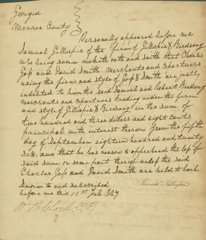
The Troup Scanning project has now added sixty-eight naturalizations requests dating from 1842 to 1908 to the records already available online.
"Prior to 1908, Superior Court judges retained the power to grant United States citizenship to eligible aliens. A complete set of naturalization papers includes the affidavit of intention, the application itself, character references, the oath of allegiance, and the judge's order granting citizenship; however, for some applicants there may be only one document. It generally took several years to gain citizenship. Naturalizations were also recorded in the minute books of the Superior Court. Some naturalizations appear in minute books but can not be found in the loose papers. Most petitions contain helpful personal information about the applicant, e.g., date and place of birth, route of immigration, length of residence in the United States and Georgia, occupation, and physical description including hair, skin and eye color."
The sixty-eight petitions are from applicants of German, Irish, Italian, Canadian, Scottish, British, Austrian, Hungarian, and Russian descent.
"Prior to 1908, Superior Court judges retained the power to grant United States citizenship to eligible aliens. A complete set of naturalization papers includes the affidavit of intention, the application itself, character references, the oath of allegiance, and the judge's order granting citizenship; however, for some applicants there may be only one document. It generally took several years to gain citizenship. Naturalizations were also recorded in the minute books of the Superior Court. Some naturalizations appear in minute books but can not be found in the loose papers. Most petitions contain helpful personal information about the applicant, e.g., date and place of birth, route of immigration, length of residence in the United States and Georgia, occupation, and physical description including hair, skin and eye color."
The sixty-eight petitions are from applicants of German, Irish, Italian, Canadian, Scottish, British, Austrian, Hungarian, and Russian descent.
Wednesday, July 15, 2009
New years now available
Several more years of documents were added to the Web site today. New years are from 1847-1849, 1856-1864, 1882-1886, and 1891-1900. Updated images have been added for 1831, 1832, 1833, 1835, 1836, 1837, 1838, 1839, 1840, 1865, 1869, and 1872. More than 4000 folders of court records are now available as part of the scanning project.
The following years are now available:
1825
1827-1840
1842-1872
1878-1886
1891-1900
Metadata records for the new additions have been created and will be added to the DLG Web site soon.
The following years are now available:
1825
1827-1840
1842-1872
1878-1886
1891-1900
Metadata records for the new additions have been created and will be added to the DLG Web site soon.
Monday, March 9, 2009
More images added to site
Several more years of documents were added to the Web site today. New years are 1844 to 1846, 1850 to 1855, 1867, and 1878 to 1880. More than 2200 folders of court records are now available as part of the scanning project.
The following years are now available:
1825
1827-1840
1842-1846
1850-1855
1865-1867
1868-1872
1878-1881
The following years are now available:
1825
1827-1840
1842-1846
1850-1855
1865-1867
1868-1872
1878-1881
Derivative creation and quality control process in DLG
Mary Willoughby at the DLG works closely with TCA on the imaging side of the project. Here's her description of the process she goes through when performing image quality control and creating derivatives:
"As part of the Troup County Superior Court Records project, I convert the document images scanned at TCA into PDF and DjVu images for online display. Along the way, I've been working with Kaye Minchew and the TCA staff to help review the images for consistency and quality and suggesting techniques and software options to help with their scanning process.
Once TCA sends us a disk (typically containing 500GB – 1 TB of tifs) I spot check its contents to make sure the scans are of consistent quality and are properly oriented and cropped. If there are problems that I feel would negatively affect usability in the finished page display I refer them back to TCA. When time and DLG workflow have allowed, we corrected some of these problems here using either BookRestorer (a batch image editing application) or a combination of ACDSee or XNView as a viewer plus Photoshop as an editor. Because of the large number of files involved in the project and the necessity of hand naming by TCA during their scanning process, I also double check the filenames using Quick File Rename, a batch file renaming program that we have found useful for many DLG projects. When fixing problem images at DLG is not an option because of other project demands, the TCA staff corrects scans they feel need improvement and sends us replacement files.
After any necessary changes are made to a set of images, I convert them to DjVu and layered PDF using the JRA Publish software suite. Both of these file formats allow you to greatly compress large images with minimal compression artifacts. They also provide page-turning, zooming, and the ability to print an enlarged version of the image you are viewing from within a web browser if you have the appropriate plug-in installed.
The final step in the DLG's role in managing the images is to move the master tif files to our archival storage system for long term preservation. Though a large amount of drive space is required for this, it is important because these images will allow us to recover from any accidental data loss that might occur in the future. Having a readily available set of high quality images for these documents also preserves our ability to undertake any conversion projects that might be necessary to preserve the usefulness of the collection should the files used to present the images become obsolete or be superceded by new technology."
"As part of the Troup County Superior Court Records project, I convert the document images scanned at TCA into PDF and DjVu images for online display. Along the way, I've been working with Kaye Minchew and the TCA staff to help review the images for consistency and quality and suggesting techniques and software options to help with their scanning process.
Once TCA sends us a disk (typically containing 500GB – 1 TB of tifs) I spot check its contents to make sure the scans are of consistent quality and are properly oriented and cropped. If there are problems that I feel would negatively affect usability in the finished page display I refer them back to TCA. When time and DLG workflow have allowed, we corrected some of these problems here using either BookRestorer (a batch image editing application) or a combination of ACDSee or XNView as a viewer plus Photoshop as an editor. Because of the large number of files involved in the project and the necessity of hand naming by TCA during their scanning process, I also double check the filenames using Quick File Rename, a batch file renaming program that we have found useful for many DLG projects. When fixing problem images at DLG is not an option because of other project demands, the TCA staff corrects scans they feel need improvement and sends us replacement files.
After any necessary changes are made to a set of images, I convert them to DjVu and layered PDF using the JRA Publish software suite. Both of these file formats allow you to greatly compress large images with minimal compression artifacts. They also provide page-turning, zooming, and the ability to print an enlarged version of the image you are viewing from within a web browser if you have the appropriate plug-in installed.
The final step in the DLG's role in managing the images is to move the master tif files to our archival storage system for long term preservation. Though a large amount of drive space is required for this, it is important because these images will allow us to recover from any accidental data loss that might occur in the future. Having a readily available set of high quality images for these documents also preserves our ability to undertake any conversion projects that might be necessary to preserve the usefulness of the collection should the files used to present the images become obsolete or be superceded by new technology."
Friday, March 6, 2009
More additions to site
We've added new images to the Web site today. These include corrected images from the following years, 1831-1833, 1835-1840, 1865, 1869, and 1872. Newly available years include 1842, 1843, and 1881.
This means that the following years are now available:
1825
1827-1840
1842-1843
1865-1866
1868-1872
1881
We've got 1320 folders of documents online. DC records have been generated and are awaiting loading into the DLG union metadata catalog. These should be available some time next week.
This means that the following years are now available:
1825
1827-1840
1842-1843
1865-1866
1868-1872
1881
We've got 1320 folders of documents online. DC records have been generated and are awaiting loading into the DLG union metadata catalog. These should be available some time next week.
Friday, January 23, 2009
Finding aids online
The finding aids for the project are available at
http://dlg.galileo.usg.edu/troup/
Also, images are available for Superior Court records for the following years--
1825
1827-1840
1865-1866
1868-1872
This represents 835 folders of documents.
Dublin Core records for these may be searched at: http://dlg.galileo.usg.edu/CollectionsA-Z/court_search.html.
http://dlg.galileo.usg.edu/troup/
Also, images are available for Superior Court records for the following years--
1825
1827-1840
1865-1866
1868-1872
This represents 835 folders of documents.
Dublin Core records for these may be searched at: http://dlg.galileo.usg.edu/CollectionsA-Z/court_search.html.
Subscribe to:
Posts (Atom)